
Plastic Bag Making Apparatus
A plastic bag making apparatus is a converting system that employs heat sealing and precision cutting mechanisms to transform continuous plastic film rolls into finished bags — including T-shirt bags, bags-on-roll, coreless rolls, and flat bags — with automated tension control, length measurement, and stacking or winding.
1. Double-rail and single-rail configurations for varying output demands.
2. Chip computer control systems for one-touch operation and fault diagnosis.
3. Factory-direct inquiries · Quote-based pricing.
Key Points
| Question | Answer |
|---|---|
| What is a plastic bag making apparatus? | A converting machine that heat-seals and cuts plastic film into finished bags — T-shirt bags, bags-on-roll, coreless rolls, flat bags, and gusseted bags. |
| How does the apparatus work? | Film unwind → sealing (heat or ultrasonic) → cutting to length → stacking or automatic winding. Chip computer control manages speed, length, and counting. |
| Single-rail vs. double-rail? | Double-rail produces two lanes of bags simultaneously, doubling output; single-rail is used for wider bags or coreless applications. |
| What films can it process? | HDPE, LDPE, LLDPE, PP, biodegradable films, and multilayer co-extruded films — typically 6–50 microns per layer. |
| What are the key components? | Unwind stand, sealing bars, cutting system, stacking tray or winder, and chip computer/PLC control system. |
| How to get a price? | No public list price; quoted by configuration. Submit bag type, dimensions, film, and speed requirements via inquiry. |
Bag Making Apparatus — Process Steps
A standard bag making apparatus operates in five stages: film unwind → sealing → cutting → stacking/winding → control & monitoring.
Film unwinding & tension control
The film roll (max Φ900mm) is mounted on an unwind stand with automatic tension control to maintain consistent feed into the sealing section.
Film guiding & forming
Guide rollers align the film; for gusseted bags, forming boards create side folds before the film enters the sealing zone.
Heat sealing
Sealing bars apply controlled heat and pressure to create bottom seals (or side seals). Independent temperature control per bar ensures seal integrity across different film types.
Precision cutting
A rotary or guillotine cutting system cuts the film to the specified bag length (200–1500mm depending on model), with accuracy maintained by the chip computer.
Stacking or winding
Finished bags are either stacked in a collection tray (flat bags) or automatically wound onto cores (bags-on-roll) with core diameters of Φ25–60mm. Coreless winding is available for eco-friendly applications.
Control & monitoring
The chip computer or PLC system manages speed, bag length, counting, temperature, and fault diagnosis — enabling one-touch operation and minimizing waste.

How does a plastic bag making apparatus work?
The core principle is "film feed + heat seal + cut to length" — the apparatus continuously unrolls film, forms seals via heated bars, cuts bags to precise length, and either stacks them flat or winds them onto rolls.
The process is driven by a chip computer or PLC control system that synchronizes film feed speed, sealing temperature, cutting timing, and counting. This ensures consistent bag length and seal quality across long production runs.
For gusseted bags (side-folded), forming boards shape the film before sealing. Double-rail configurations run two parallel lanes, effectively doubling throughput without increasing floor space proportionally.
Finished bags exit as stacked flat bags (for manual packing) or as wound rolls (for retail point-of-sale dispensing). Coreless winding eliminates paper core waste, offering an eco-friendly alternative.
Bag-Making Apparatus Process Flow
The material path can be summarized as: film roll → unwind → guiding/forming → sealing → cutting → stacking/winding → finished bags.
Film roll mounting
Unwind & tension
Guiding & forming
Heat sealing
Precision cutting
Stacking tray
Automatic winding
Finished bags

Note: The above diagram is a logical schematic. Actual configurations — single-rail vs. double-rail, coreless vs. with core, and stacking vs. winding — vary by model and application.
What is the difference between a bag making apparatus and a bag making machine?
The terms are often used interchangeably, but "apparatus" typically implies a more integrated, engineered system with advanced control, while "machine" may refer to a broader category. Both convert film into finished bags via sealing and cutting.
Terminology context
"Apparatus" is commonly used in patent and technical documentation; "machine" is the everyday commercial term.
Control sophistication
An apparatus often implies chip computer or PLC control with integrated fault diagnosis; basic machines may have simpler controls.
System integration
Apparatus suggests a complete system — unwind, sealing, cutting, and winding/stacking — fully integrated; machines can be modular.
Application scope
Both produce the same bag types; the distinction is more about engineering precision and documentation language.
Typical Products & Applications
Plastic bag making apparatus produces a wide range of bags for retail, food service, waste management, and industrial packaging.
Retail & Consumer Bags
- ● T-shirt shopping bags with die-cut handles
- ● Garment bags with gusset side folds
- ● Produce bags on roll for supermarkets
Waste & Industrial Bags
- ● Garbage bags — flat and on-roll
- ● Food packaging bags for bakeries and delis
- ● Biodegradable and compostable bags
What parts of a bag making apparatus should you pay attention to?
First determine the bag type (T-shirt, on-roll, coreless, flat), then match rail configuration, sealing system, cutting method, and winding/stacking unit to your production needs.
Rail configuration
Double-rail doubles output — ideal for high-volume retail bags. Single-rail suits wider bags or coreless applications.
Sealing system
Heat sealing is standard; independent temperature control per bar ensures consistent seals across different film types and thicknesses.
Cutting mechanism
Rotary cutting for high-speed continuous operation; guillotine cutting for precise length control on thicker films.
Winding vs. stacking
Automatic winding onto cores (Φ25–60mm) for retail rolls; coreless winding for eco-friendly applications; stacking trays for flat bags.
Control system
Chip computer or PLC control with touch-screen interface, automatic counting, and fault diagnosis reduces waste and operator intervention.
Film compatibility
Ensure the apparatus supports your film type — HDPE, LDPE, LLDPE, PP, biodegradable — and thickness range (typically 6–50 microns).
Pricing information:The price of a plastic bag making apparatus varies considerably depending on rail configuration (single vs. double), bag type, width, speed, automation level, and winding system. CBADEN Machinery operates on a quotation-based pricing model and does not publish a price list on its website. CBADEN Machinery Group is a factory-direct B2B manufacturer in China with more than 30 years of manufacturing and selling experience for bag-making machinery, serving customers across global markets.
How does CBADEN Machinery support bag making apparatus?
CBADEN Machinery Group is a factory-direct manufacturer of plastic bag making apparatus, designing and producing double-rail and single-rail systems for T-shirt bags, bags-on-roll, coreless rolls, and flat bags.
Positioning:Industrial converting equipment — bag making apparatus; B2B export, configured upon inquiry.
Capability range:Double-rail and single-rail configurations; T-shirt, on-roll, coreless, and flat bag production.
Key features:Independent winders, chip computer control systems, automatic tension control, and precision cutting.
Factory strength:30+ years of manufacturing and selling experience; export track record across global markets.
Years of experience
Export markets worldwide
Configured to your needs
Direct B2B manufacturer
Select by Application for Bag Making Apparatus

Double-Rail Bag Apparatus
Application:High-speed flat bags and general-purpose bags.
Specs:Bag width 80–150mm, length 200–900mm, speed 80–100m/min ×2 lines, film 6–25 micron.
Control:Independent winder + chip computer control.
VIEW →
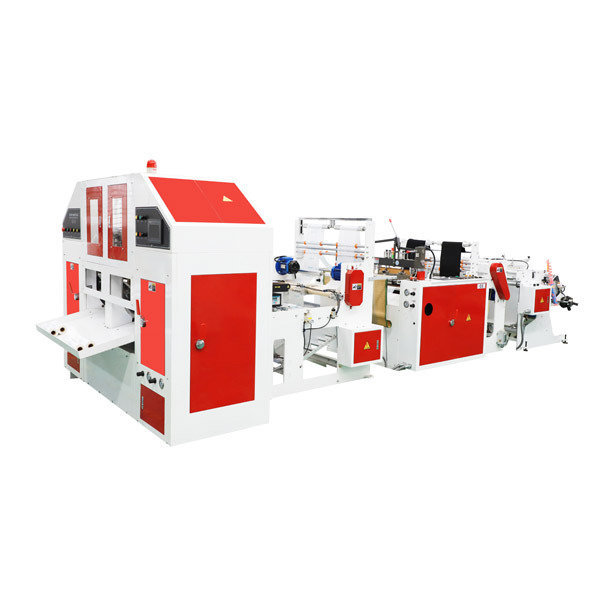
Double-Rail Bag Apparatus
Application:Heavy-duty wide bags for retail and waste.
Specs:Bag width 150–400mm, length 200–800mm, speed 300 pcs/min ×2 lines, film 8–35 micron.
Control:Independent winder + chip computer control.
VIEW →
Application:Retail shopping and garment bags with side folds.
Specs:Bag width 330mm, length 330–1000mm, rolling size 160–330mm, film 10–35mm.
Power:25kWA total, 6HP air consumption.
VIEW →
Application:High-volume T-shirt bag production for household and commercial use.
Specs:Bag width 200–400mm, length 320–650mm, speed 150–300 pcs/min, film 10–50 micron.
Material:100% HDPE film compatible.
VIEW →
Application:Eco-friendly coreless bags-on-roll — no paper core waste.
Specs:Bag width 400–650mm, length 300–1500mm, speed 80–100 m/min, film 0.01–0.05mm.
Rail:Single-rail configuration.
VIEW →
Application:Supermarket produce bags and garbage bags on rolls.
Specs:Bag width 150–400mm, length 200–800mm, core Φ25–60mm, speed 300 pcs/min ×2 lines.
Control:Independent winder + chip computer control.
VIEW →
Frequently Asked Questions
Ready to specify your bag making apparatus?
CBADEN Machinery Group — factory-direct B2B manufacturer in China with 30+ years of experience in bag making equipment.