Automatic Bag Making Machine Technical Deep Dive: PLC Programming and Real-Time Task Scheduling
Automatic bag making machines rely on sophisticated PLC (Programmable Logic Controller) systems to coordinate all machine functions – film feed, sealing, cutting, stacking, and safety – with millisecond precision. The PLC executes a cyclic program that reads inputs, processes logic, and writes outputs. The total scan time must be less than the machine's cycle time; for a 250 BPM machine (4.16 ms per bag), the scan time must be under 2 ms to leave margin for communication and other tasks. To achieve this, the program is optimized using structured text (ST) or ladder logic with efficient instructions. Critical tasks like temperature PID control and registration correction are executed in dedicated interrupt routines that run at higher priorities, independent of the main scan. The PLC's operating system is an RTOS (Real-Time Operating System) that ensures deterministic task execution – tasks are scheduled based on priority, and the highest priority task preempts lower ones. The motion control for servo axes is often handled by a dedicated motion controller (or a PLC with integrated motion) that uses a separate high-speed communication bus (EtherCAT or Profinet) to synchronize axes at cycle times of 1 ms or less.
The main PLC program is structured in a state-machine format. States include: IDLE (waiting for start), RUNNING (normal production), STOPPING (controlled stop), and ALARM. Within RUNNING, sub-states manage each cycle: FILM_ADVANCE (pull film to length), SEAL (close sealing bar, apply heat, dwell, open), CUT (operate cutter), and STACK (discharge bundle). The transition between states is triggered by feedback from sensors (position, temperature, pressure). The state machine ensures that each action occurs in the correct sequence and that no two actions overlap in a way that causes mechanical interference. For example, the sealing bar must not close while the film is being pulled. The timings for each state are calculated based on the machine's mechanical parameters (acceleration, deceleration, dwell). The cycle time is the sum of all state durations; if the total exceeds the target, the engineer must reduce individual times by optimizing acceleration or reducing dwell.
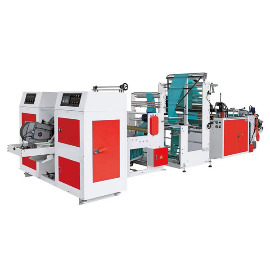
Plastic Bag Making Machine
Interrupt handling is crucial for time-critical events. For example, when a registration mark is detected by a camera, the signal must be processed within microseconds to adjust the film pull phase. This is handled by a hardware interrupt that triggers a fast-response routine. The routine calculates the phase error and sends a correction to the motion controller. The correction is applied in the next cycle, not the current one, to avoid instability. The interrupt routine must be short (under 100 microseconds) to avoid delaying other tasks. Similarly, emergency stop signals are handled by a separate safety PLC that acts independently of the main PLC, ensuring fail-safe operation.
Data exchange with the HMI (Human-Machine Interface) is done via a separate communication task. The HMI displays real-time production data (BPM, count, temperature) and allows parameter changes. The PLC sends data to the HMI at a lower priority, typically every 100-500 ms. Parameter changes from the HMI are validated by the PLC before being applied to prevent unsafe settings. The PLC also logs data – production counts, alarms, and parameter changes – in a non-volatile memory for traceability.
Motion control synchronization: The film pull, sealing bar, and cutter axes are synchronized using a virtual master axis. The master generates a time base; all slave axes follow electronic cam profiles referenced to the master. The motion controller calculates the position setpoints for each axis at the communication cycle rate (e.g., 1 ms). The servo drives have their own internal position control loops with high bandwidth (200-500 Hz) to track the setpoints with low following error (typically <0.05 mm). The cam profiles are generated offline based on the machine's mechanical constraints and stored as arrays; for different bag lengths, the profiles are scaled. During acceleration and deceleration, the master axis speed changes, and all slaves follow synchronously, maintaining the correct phase.
By mastering PLC programming and real-time task scheduling,
automatic bag making machines achieve high-speed, reliable operation with minimal human intervention. The deterministic control ensures consistent bag quality, and the data logging enables continuous improvement and predictive maintenance, making these machines the backbone of modern bag manufacturing.