Automatic Bag Making Machine Technical Deep Dive: Sensor Fusion and Fault Detection
Modern automatic bag making machines are equipped with a wide array of sensors – temperature (thermocouples), pressure (load cells), position (encoders), vibration (accelerometers), current (motor drives), and vision (cameras). The integration of these sensors, known as sensor fusion, allows the machine to monitor its own health and detect faults in real-time. By combining data from multiple sensors, the system can distinguish between different types of anomalies and pinpoint the root cause. For example, a sudden increase in sealing bar temperature accompanied by a drop in motor current may indicate a heater failure; a rise in vibration on the cutter axis may indicate a dull blade. The sensor data is sampled at high rates (1-10 kHz) and processed by a dedicated diagnostic unit, which can be an edge device or a separate PLC module. The processing involves filtering (using Kalman filters or moving averages) to remove noise, then feature extraction – calculating metrics like RMS, peak-to-peak, and spectral components.
Fault detection is typically based on threshold monitoring: if a sensor value exceeds a predefined limit, an alarm is triggered. However, this simple approach can cause false alarms due to noise. Advanced systems use model-based detection: a mathematical model of the machine's behavior is created from healthy operation data. The model predicts the expected sensor values based on inputs (e.g., speed, temperature setpoint). The residual (difference between actual and predicted) is monitored; a residual exceeding a statistical limit indicates a fault. For example, a model of the sealing bar temperature might predict its response to speed changes; if the actual temperature drops more than predicted, the heater may be underperforming. Machine learning algorithms, such as autoencoders or support vector machines, can learn the normal patterns from historical data and detect anomalies without a physical model. These methods are more sensitive to subtle faults that do not exceed fixed thresholds.
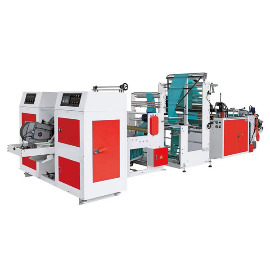
Plastic Bag Making Machine
The vision system is a powerful sensor for quality inspection. High-speed cameras capture images of the seal, print registration, and bag dimensions. The images are processed using deep learning networks (e.g., convolutional neural networks) that are trained to classify defects: burns, wrinkles, misregistration, and incomplete seals. The vision system can also measure seal width and length. The detection results are fed back to the control system to adjust parameters or reject defective bags. The vision system's latency must be less than the cycle time; this is achieved by using dedicated FPGA-based processing or edge AI chips. The system can also monitor the film surface for contaminants or gels, alerting the operator to upstream issues.
Fault diagnostics go beyond detection to identify the specific component and cause. For instance, a vibration signature analysis can distinguish between bearing wear, imbalance, and misalignment. Each fault type has a unique frequency spectrum; the system uses Fast Fourier Transform (FFT) and compares the spectrum with a library of known fault signatures. The diagnostic system can provide a recommendation – e.g., "Replace bearing on cutter shaft within 100 operating hours." This allows maintenance to be planned, reducing downtime.
Data fusion and diagnostics are integrated with the machine's HMI, which displays the health status of each subsystem. The system can also send alerts to a remote monitoring center or to the supplier's service team. The historical data is used for continuous improvement – if a certain fault occurs frequently, the design or maintenance schedule is updated. By implementing robust sensor fusion and fault detection,
automatic bag making machines achieve high reliability, minimizing unplanned downtime and maintaining consistent production quality, which is critical for just-in-time delivery in packaging operations.