Bag Forming Machine Technical Deep Dive: Bag Length Control and Registration Accuracy
Accurate bag length control is essential for producing uniform bags and maintaining print registration. In a bag forming machine (especially VFFS), the bag length is determined by the amount of film pulled through the forming tube before the cross-seal is applied. The film pull is typically achieved by a pair of servo-driven pull belts or rollers located below the sealing jaws. The pull servo follows a position profile: it accelerates, runs at constant speed, and decelerates to a stop. The total distance traveled during this motion equals the bag length plus any overlap for sealing. The servo's encoder provides precise position feedback, but the actual film length may differ from the commanded length due to film slip, stretch, or thermal expansion. Therefore, closed-loop control using a registration sensor is employed. A print mark on the film is detected by a photoelectric sensor or a camera; the distance between successive marks is measured and compared to the setpoint. Any error is used to adjust the pull distance for the next cycle.
The control algorithm is typically a PI (proportional-integral) controller with a feed-forward term. The proportional gain corrects the current error, the integral term eliminates steady-state offset, and the feed-forward anticipates the required adjustment based on the speed. The adjustment is applied as a phase shift to the pull servo's cam profile. The phase shift is limited to a safe range (e.g., ±5% of bag length) to avoid excessive correction that can cause film stress. For high-speed machines, the response time of the registration system is critical – a delay of even 10 ms can cause a 1 mm error at 300 BPM. Therefore, the sensor must have a fast response (<1 ms), and the PLC must have a fast scan time (≤1 ms). The sensor's sensitivity must be adjustable for different print mark colors and contrasts.
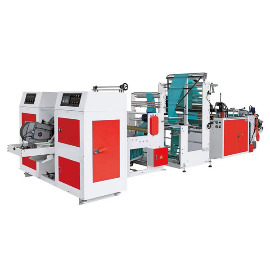
Plastic Bag Making Machine
Compensation for film stretch and slip: Films with high elongation (e.g., LDPE) can stretch under tension, changing the actual bag length. The stretch is proportional to tension and film modulus; a higher tension causes more stretch. To compensate, the control system can adjust the pull distance based on a tension reading – higher tension reduces the commanded distance. This is a feed-forward compensation. Film slip occurs when the pull belts or rollers lose grip on the film, often due to low friction or contamination. Slip causes short bags. To prevent slip, the nip pressure is increased, and the roller surfaces are maintained clean. Some machines use a second encoder on a free-running roller to measure the actual film speed and compare with the pull roller speed; any difference indicates slip and triggers a correction or an alarm.
For machines with registration mark detection, the marks must be printed with consistent quality – poor contrast or smeared marks cause detection errors. The sensor must be aligned to detect the mark consistently; misalignment causes phase errors. Regular calibration of the sensor using a test film is necessary. The sensor's mounting must be rigid to prevent vibration-induced jitter.
Bag length accuracy is also affected by the sealing dwell time – during the seal, the film is stopped. The pull belts must stop and hold the film exactly at the correct position; any drift during the dwell causes length variation. The servo's holding torque must be sufficient to prevent movement, and the belts must have low backlash. For high-speed machines, the acceleration and deceleration profiles of the pull servo must be optimized to reduce settling time, allowing maximum time for sealing. The control system can use a "jerk-limited" profile to minimize vibration.
By implementing robust bag length control and registration systems,
bag forming machines achieve high accuracy (typically ±0.5 mm) even at high speeds, ensuring consistent bag dimensions and print alignment, which is critical for customer satisfaction and automated downstream processes. The control system's data logging also helps in diagnosing issues related to film quality or machine wear, enabling proactive maintenance.