Bag Forming Machine Technical Deep Dive: Forming Collar Geometry and Film Flow Dynamics
The forming collar (or shoulder) is the heart of a vertical form-fill-seal bag forming machine, responsible for converting a flat film into a cylindrical tube. Its geometry directly affects film tension, wrinkling, and the consistency of the back seal. The collar is typically a curved metal surface that gradually transforms the flat film path into a circular cross-section around the filling tube. The design must ensure that the film slides smoothly without excessive drag, which can cause stretching or burning (from friction). The collar's surface is polished to a mirror finish and often coated with a low-friction material like PTFE. The key geometric parameters include the collar's angle of inclination, its radius of curvature, and the transition length from flat to tube. The film's width must match the tube circumference plus an overlap for the back seal. The collar's shape is critical for different film widths and bag sizes – a universal collar may accommodate a range of widths, but optimal performance requires a dedicated collar for each width. The film's coefficient of friction (COF) on the collar determines the driving force needed; a COF of 0.15-0.25 is typical. Higher COF causes film drag, leading to tension spikes and wrinkles.
Computational fluid dynamics (CFD) and finite element analysis (FEA) are used to simulate the film flow over the collar. The film is modeled as a thin shell with material properties (tensile modulus, yield strength). The simulation predicts the stress distribution and identifies zones of high strain that may cause necking or wrinkling. Based on the results, the collar's curvature is optimized to minimize strain gradients. For high-speed forming (above 150 m/min), the film's inertia becomes significant – the collar must be designed to guide the film without flutter. This often requires a more gradual transition and additional guide rollers.
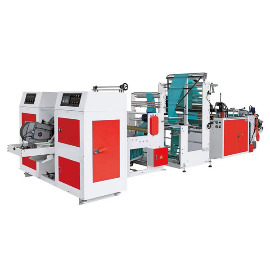
Plastic Bag Making Machine
The filling tube's diameter and shape also affect forming. For free-flowing products, a round tube is used; for products that tend to bridge, a rectangular or oval tube may be better, but this requires a correspondingly shaped collar. The film wraps around the tube, and the overlap area is where the back seal is made. The back seal can be a lap seal (overlap) or a fin seal (overlap folded flat). The former is simpler but creates a thicker seam; the latter is stronger but requires an additional folding device. The back seal bar is located on the side of the tube, and its temperature and pressure must be precisely controlled.
Film tension during forming is controlled by the pull belts below the forming area. The tension must be just enough to keep the film in contact with the collar but not so high as to stretch it. The tension setpoint is typically 5-15 N. The forming collar's surface temperature can affect film friction – a heated collar (30-50°C) reduces COF for some films. Some collars have air holes that provide a thin air cushion to reduce friction, similar to air bearings, but this requires compressed air and may cause film flutter.
Wrinkling is the most common defect in forming. It occurs when the film's width is too large for the collar, or when the collar is misaligned. To correct, the film width must be trimmed or the collar adjusted. The edge guide before the collar ensures the film enters centered. The collar's position relative to the tube must be precisely set – any tilt causes uneven tension. Regular cleaning of the collar is essential, as dust or resin residue increases friction. By optimizing forming collar geometry and film flow dynamics,
bag forming machines can achieve high-speed, defect-free tube formation, ensuring consistent bag quality and minimal waste.