Bag Machine Technical Deep Dive: Cutting Mechanism Design and Precision Optimization
The cutting mechanism of a bag machine is responsible for separating the continuous film web into individual bags with clean, straight edges. The quality of the cut affects bag appearance, sealing integrity (if the cut is too close to the seal), and downstream handling. Two primary cutting technologies dominate: rotary knife and guillotine. Rotary cutters use a cylindrical blade that rotates against a fixed anvil roller, shearing the film continuously. They are preferred for high-speed machines (above 200 BPM) because they produce a continuous cut with minimal vibration and noise. The rotary blade is typically made of high-speed steel or tungsten carbide, with a helical or straight edge. The anvil roller is made of hardened steel or polyurethane, providing a resilient counter-surface. The blade's peripheral speed must match the film speed to avoid dragging – this is achieved by synchronizing the blade servo with the film pull servo. The cutting force is determined by the blade's sharpness, the film's shear strength, and the gap between blade and anvil. A gap of 0.01-0.03 mm is typical; too large a gap causes incomplete cuts, too small increases wear. The blade wear rate is about 0.001 mm per million cuts; after 10 million cuts, the blade must be reground or replaced.
Guillotine cutters use a straight blade that moves vertically (or diagonally) against a fixed anvil, cutting the film in an intermittent action. They are simpler and cheaper, suitable for lower speeds (up to 150 BPM) and thicker films (over 100 microns). The blade is driven by a pneumatic cylinder, a servo-driven crank, or a cam mechanism. The cutting action includes a shearing motion – the blade is angled slightly (1-3 degrees) to reduce the required force. The blade clearance is critical: 0.02-0.05 mm for clean cuts. Guillotine cutters produce more dust and noise than rotary cutters, but they can handle multi-layer laminates and woven fabrics better. The blade life is shorter – 1-2 million cuts – due to the impact nature of the cut. Both types require precise synchronization with the film feed: the cut must occur exactly when the film has advanced to the correct length. This is achieved by a registration sensor that triggers the cut when a print mark passes. The cut length tolerance is typically ±0.5 mm.
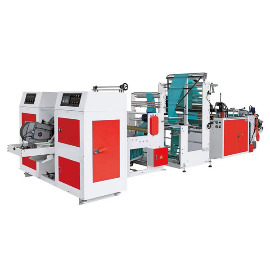
Plastic Bag Making Machine
Blade geometry and sharpness are paramount for cut quality. The blade edge angle (bevel) ranges from 15 to 30 degrees – a smaller angle produces a sharper edge but less durability. For rotary blades, the helix angle (if helical) improves cutting smoothness by creating a progressive cut across the width. The blade surface is hardened to HRC 58-62 for wear resistance. Some blades are coated with TiN or CrN to reduce friction and increase life. The anvil surface must be smooth and concentric; any eccentricity causes variations in the gap. Anvil wear is monitored by measuring the cut quality – if the cut becomes ragged, the anvil may need to be reground or replaced.
Registration synchronization is a closed-loop system. A photoelectric sensor or CCD camera detects a registration mark on the film. The time between marks represents the desired bag length. The control system calculates the actual film feed per cycle and compares it with the setpoint. If an error exists, the cut trigger is advanced or delayed by adjusting the phase of the cutting axis. For rotary cutters, this is done by dynamically shifting the blade's electronic cam profile. The response time of the registration system must be under 1 ms for high speeds. Advanced systems use a predictive algorithm that anticipates the film speed change during acceleration/deceleration, maintaining registration even during speed changes.
Cutting force and energy consumption: The cutting force is proportional to film thickness and shear strength. For 50-micron LDPE, the force is about 100 N per meter of width; for 200-micron HDPE, it exceeds 500 N/m. The cutting mechanism must provide sufficient force without causing excessive frame vibration. The energy consumed by cutting is a small fraction of the total machine power, but optimizing blade sharpness reduces motor load. Some machines use an air knife to assist in separating the film from the blade, reducing sticking. Cooling of the blade is sometimes needed for continuous high-speed cutting of thick films to prevent heat buildup that can melt the film edge. By refining cutting mechanism design and control,
bag machines can achieve clean, precise cuts at high speeds, contributing to overall bag quality and production efficiency.