Bag Machine Technical Deep Dive: Sealing Bar Design and Thermal Uniformity Optimization
The sealing bar is the most critical component of a bag machine, as it directly determines seal quality. Its design must balance thermal performance, mechanical strength, and wear resistance. The sealing bar typically consists of a base material (copper, aluminum, or steel) with embedded heating elements, a wear-resistant surface coating, and thermocouples for temperature feedback. Copper is preferred for its high thermal conductivity (401 W/m·K), which allows rapid heat distribution and recovery, but it is heavy and expensive. Aluminum (205 W/m·K) offers a lighter, cheaper alternative with adequate conductivity for most applications. Steel (45 W/m·K) is used for heavy-duty machines but requires more heaters to achieve uniform temperature. The choice depends on the machine's speed – high-speed machines require copper or aluminum to maintain temperature during short dwell times. The bar's cross-section is designed to minimize thermal gradient – a rectangular or trapezoidal shape with heaters placed near the sealing surface. The heater type is usually cartridge heaters inserted into holes drilled along the bar, or tubular heaters clamped to the back. Cartridge heaters offer better thermal coupling and faster response. The heater power density is typically 5-15 W/cm², with total power ranging from 2-10 kW for a 1200 mm wide bar.
Thermal uniformity across the bar is achieved by optimizing heater spacing and using multiple temperature zones. Finite element thermal analysis (FEA) simulates the temperature distribution under steady-state and transient conditions. The model includes heat generation in the heaters, conduction through the bar, convection and radiation losses to the environment, and contact resistance with the film. Based on FEA results, heater positions are adjusted – typically with higher heater density near the bar ends where heat loss is greater. The bar surface is coated with a non-stick material such as PTFE (Teflon) or silicone rubber, which also acts as a thermal insulator to prevent film sticking. The coating thickness (0.1-0.5 mm) adds thermal resistance; a thicker coating reduces heat transfer and requires higher bar temperatures. The coating's wear life is limited to 1-3 months of continuous operation, after which it must be replaced. Some advanced bars use a ceramic coating with better thermal conductivity and longer life.
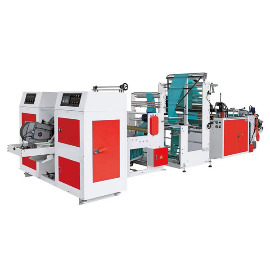
Plastic Bag Making Machine
Temperature control is implemented using PID controllers with anti-windup and auto-tuning features. The thermocouples are placed as close as possible to the sealing surface – typically within 2-5 mm – to minimize measurement lag. The controller's proportional band, integral time, and derivative time are tuned based on the bar's thermal time constant (typically 10-30 seconds). For high-speed cycles, the temperature can drop by 5-10°C during the dwell because heat is transferred to the film; the controller must quickly restore the setpoint. Feed-forward control is used: the controller anticipates the temperature drop based on the cycle rate and applies additional power before the drop occurs. The heating elements are driven by solid-state relays (SSRs) with zero-crossing switching to reduce electrical noise. The control accuracy is typically ±1°C.
Mechanical design of the sealing bar includes the actuation mechanism – pneumatic cylinders or servo motors. The bar must apply uniform pressure across its entire length. Any deviation in parallelism between the upper and lower bars causes uneven pressure, leading to weak seals on one side. The bar is guided by linear bearings or wear strips to maintain alignment. The closing force is calculated based on the seal area and required pressure – for LDPE, 2-4 bar (200-400 kPa) is typical. The bar's mass and inertia determine the achievable acceleration; lightweight designs use aluminum with hollow chambers or lattice structures. For high-speed machines (above 200 BPM), the bar may be counterbalanced with springs or air cushions to reduce the load on the actuator.
Wear and maintenance of the sealing bar are significant factors. The coating wears due to friction and thermal cycling, exposing the metal surface which can cause film sticking and burn marks. Regular inspection with a feeler gauge checks flatness – a deviation of more than 0.05 mm requires resurfacing. The heating elements have a finite life (2,000-5,000 hours) and degrade gradually; resistance measurement can detect deterioration. Thermocouples may drift; recalibration is recommended monthly. Advanced
bag machines include a self-diagnostic system that monitors heater current and calculates remaining life. By optimizing the sealing bar design, engineers can achieve superior seal strength, longer bar life, and reduced energy consumption, directly improving bag quality and production efficiency.