Bag Maker Technical Deep Dive: High-Speed Stacking and Compensating Mechanisms
The stacking system of a bag maker is often the bottleneck in high-speed production, as it must handle bags at rates of 200+ per minute while counting, compressing, and forming neat bundles. The system comprises a conveyor that transports bags from the cutting station to the stacker, a counting sensor, a compression plate, and a bundle discharge mechanism. The bags are delivered in a continuous stream, overlapping slightly to reduce the spacing. The conveyor speed must match the bag output – for 250 BPM, the conveyor speed is typically 30-50 m/min depending on bag length. The stacking begins with a reciprocating or oscillating conveyor that drops bags onto a platform, building a stack layer by layer. The drop height is minimized to prevent bag misalignment or wrinkling. An air blower or electrostatic eliminator separates bags to prevent sticking. The stack counter uses a photoelectric sensor or a proximity switch that detects each bag as it passes a fixed point. The counting accuracy must be 100% – miscounts cause customer complaints and rework. To ensure accuracy, a dual-sensor system is often used: one sensor detects the leading edge, another the trailing edge, and the logic confirms a valid bag only if both edges are detected within a time window. This rejects false counts from dust or film flutter.
Compression is essential to reduce the stack height for bundling. A compression plate descends onto the stack periodically, applying pressure to flatten the bags. The pressure is set to avoid damaging the bags – typically 2-5 kPa. The compression force is applied for 0.5-1 second, synchronized with the stack building. Some machines use a pre-compression stage before the main stack to improve bundle consistency. After the stack reaches the preset count (e.g., 50, 100, or 200 bags), the discharge mechanism pushes the bundle onto a conveyor or a packing table. The discharge pusher is pneumatically or servo-driven, with a speed that matches the bundle's weight to avoid scattering. The bundle is then wrapped or placed into cartons manually or automatically. For fully automatic lines, the bundle is conveyed to a shrink wrapper or a case packer.
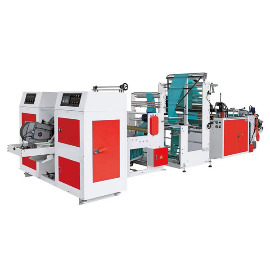
Plastic Bag Making Machine
Challenges in high-speed stacking include maintaining alignment – the bags must be squared and aligned to form neat stacks. Misalignment occurs due to air currents, static, or uneven conveyor speed. To address this, side guides and overhead rollers are used to keep the bags straight. The conveyor belts are made of anti-static material to reduce electrostatic attraction. For clear or thin films, a vacuum conveyor is sometimes used to hold the bags flat during transport. The stacking station is also equipped with a reject gate that diverts defective bags (detected by vision inspection) into a reject bin, preventing them from entering the stack.
The control system for stacking coordinates the conveyor speed, stack count, compression timing, and bundle discharge. The PLC uses counters and timers with high resolution (1 ms) to maintain accuracy. The stack height is monitored by a proximity sensor that detects the top of the stack; if the stack is too high, the machine reduces speed to allow the stacker to catch up. The bundle discharge is triggered when the count reaches the setpoint, and a new stack begins. The machine's HMI displays the stack count, total production, and reject count. For batch production, the stacker can be programmed to produce bundles of different counts for different orders.
Maintenance of the stacking system involves cleaning the conveyor belts, sensors, and compression plate regularly. The air blowers need filter cleaning. The discharge pusher's guide rails must be lubricated. The stacking platform is adjusted periodically to ensure it is level. By optimizing the stacking and handling system,
bag makers can achieve high-speed, accurate bundle formation, reducing labor costs and ensuring that finished bags are ready for packaging and shipment with minimal manual intervention.