Bag Making Machine Automation Technical Deep Dive: PLC-Based Motion Control and Electronic Camming
The automation of bag making machines is centered on PLC-based motion control systems that coordinate multiple servo axes with high precision. The motion controller (integrated with the PLC or separate) generates electronic cam profiles for each axis (film pull, sealing bar, cutter, punch, stacker). The cam profiles define the position, speed, and acceleration of each axis relative to a virtual master axis. The virtual master axis provides a time base; all slave axes are electronically geared to this master. The cam profiles are generated based on the machine's mechanical constraints (acceleration limits, stroke lengths) and the desired cycle time. For a typical cycle, the film pull axis follows a trapezoidal velocity profile with S-curve acceleration. The sealing bar axis follows a profile that includes a rapid approach, a dwell (for sealing), and a rapid retract. The cutter axis follows a profile that is synchronized with the film pull. The cam profiles are stored as arrays of position values (e.g., 1024 points per cycle) in the motion controller's memory. The controller interpolates between points to provide smooth motion. The cam profiles can be scaled for different bag lengths by adjusting the master axis speed. The motion controller communicates with the servo drives via a high-speed bus (EtherCAT, Profinet) with cycle times of 1 ms or less. The drives have their own position and velocity loops, but the motion controller provides the position setpoints. The position error (following error) is monitored; if it exceeds a limit, the machine stops.
Real-time control: The PLC executes the main logic (sequence control, safety, HMI) in a cyclic scan. The scan time is typically 1-2 ms. Critical tasks, such as registration correction, are handled by interrupt routines with higher priority. The PLC receives signals from sensors (photoelectric, pressure, temperature) and updates the motion controller's setpoints. For example, if the registration sensor detects an error, the PLC calculates a phase shift and sends it to the motion controller, which adjusts the film pull cam profile on the next cycle. The response time of the registration system is critical; the total latency (sensor detection + PLC processing + motion controller update + servo response) must be under 5 ms to maintain accuracy at 250 BPM. The PLC also handles the safety functions (emergency stop, light curtains) using a separate safety PLC or safety-rated I/O. The safety PLC communicates with the motion controller to safely stop the axes. The HMI (touchscreen) interacts with the PLC, allowing the operator to set parameters, view production data, and diagnose alarms. The HMI also has a recipe management system that stores all machine settings for each bag type.
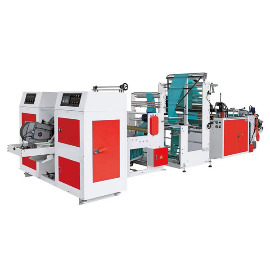
Plastic Bag Making Machine
Electronic camming advantages: 1) Flexibility – the cam profiles can be easily changed for different bag lengths by adjusting the master axis speed. 2) Precision – servo systems provide high positional accuracy (0.01 mm). 3) Speed – the acceleration and deceleration profiles can be optimized to reduce cycle time. 4) Diagnostics – the motion controller logs position errors and torque, enabling predictive maintenance. 5) Integration – the electronic cam can be synchronized with external systems (e.g., upstream extruder). The electronic camming also allows for "flying" operations, where the sealing bar or cutter moves with the film during the operation, reducing the need for stops. This increases speed but requires more complex cam profiles. The motion controller also supports "phase shifting" – the cam profile can be shifted in phase to correct registration errors without changing the profile shape. This is done by adding an offset to the master axis position. The phase shift is applied gradually to avoid jerks.
Tuning and optimization: The servo gains are tuned using the motion controller's autotune function. The autotune measures the system's inertia and friction and calculates the optimal gains. The gains are then fine-tuned manually for critical axes. The cam profiles are optimized using simulation tools that predict the axis performance. The simulation considers the motor torque limits and the mechanical load. The profiles are validated during the FAT by running the machine at maximum speed and measuring the following error. If the following error is high, the acceleration is reduced or the gains are increased. The motion controller also has a "camming" mode where the axes can be manually jogged for setup. The automation system is a key differentiator for bag making machines; a well-tuned system achieves high speed and precision with minimal mechanical stress.