Bag Making Machine Bag Counting Technical Deep Dive: Bundle Discharge and Batch Control Algorithms
Bag counting is not just about measuring the number of bags; it is about controlling the bundle discharge process to ensure that each bundle contains exactly the specified number of bags. The machine's control system uses a batch control algorithm. The algorithm has a counter that increments with each bag. When the counter reaches the bundle size (e.g., 100), it triggers the discharge sequence. The discharge sequence includes: stopping the stacking conveyor (if intermittent), activating the pusher or discharge gate, and resetting the counter. The discharge must be completed before the next bag arrives. The timing is critical: if the discharge takes too long, the next bag may be misaligned or cause a jam. The discharge time is typically 0.5-1 second. The stacker uses a movable platform that descends as the stack grows; when the bundle is complete, the platform drops to a discharge position, and the pusher moves the bundle onto a conveyor. The platform then returns to the stacking position. The control algorithm ensures that the platform is in the correct position for each bag. The algorithm also handles the case of a "partial bundle" if the machine stops – the count is saved and resumed when the machine restarts. The batch control also includes a "bundle count" that tracks the number of bundles produced. This is used for production monitoring.
Stacker synchronization: The stacker's movements (platform lowering, pusher) are synchronized with the bag counting. The platform's lowering is based on the stack height; a sensor measures the stack height and adjusts the platform position. The stack height is also estimated from the bag thickness and count; the algorithm uses a feed-forward to move the platform before the height changes. The pusher's movement is triggered when the count is reached; the pusher must be fully retracted before the next bag arrives. The machine's control system uses a state machine for the stacker: IDLE, STACKING, DISCHARGING, and RETURNING. The state transitions are based on the count and the sensor feedback. The stacker's motor is servo-controlled for precise positioning. The stacker also includes a compression plate that presses the stack periodically; the compression cycle is timed to occur every 10-20 bags, not interfering with the discharge. The compression force is set to compact the stack without damaging the bags. The batch control algorithm also includes a "bundle complete" signal that can be used to trigger a labeling or wrapping machine.
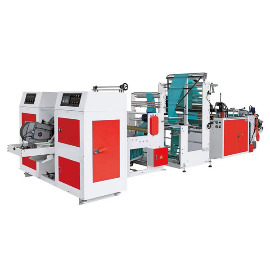
Plastic Bag Making Machine
Error handling and diagnostics: If the stacker fails to discharge (e.g., jam), the machine stops to prevent damage. The control system logs the error and displays it on the HMI. The operator can clear the jam and resume. The batch control also includes a "manual override" for maintenance. The count is stored in non-volatile memory to survive power loss. The algorithm also monitors the discharge time; if it exceeds a threshold, an alert is generated. The bundle integrity is verified by a weight check – the bundle weight is compared to the expected weight. If the weight deviates, the bundle is flagged. The batch control is calibrated during the FAT; the bundle size and discharge timing are verified. The algorithm can be adjusted for different bag sizes and bundle counts.
Integration with packaging: The bundle discharge system can be integrated with a downstream wrapping or packing machine. The control system sends a "bundle ready" signal to the wrapping machine, and the bundle is transferred. The wrapping machine confirms receipt, and the stacker continues. The count of bundles is tracked; when the order is complete, the machine stops or switches to a new order. The batch control algorithm is a critical part of the machine's automation; it ensures that the right number of bags are packed and ready for shipment. By using robust counting logic and synchronization, bag making machines achieve reliable, accurate bundle production, reducing labor and improving efficiency.