Bag Making Machine Common Problems Technical Deep Dive: Film Breakage and Tension Spike Analysis
Film breakage is a disruptive problem that causes downtime and waste. It typically occurs at the unwinding, during acceleration, or at the splicing point. The primary cause is a tension spike – a sudden increase in film tension that exceeds the film's tensile strength. Tension spikes can be caused by: 1) The dancer arm hitting its mechanical stop due to rapid speed changes; 2) The unwinding brake failing to release; 3) The pull roller accelerating too fast; 4) A splice that is too thick or not properly made. To diagnose, the machine's control system logs tension, speed, and dancer position at high frequency (1 kHz). A spike is identified as a tension value exceeding the setpoint by more than 50% for more than 10 ms. The data is analyzed to pinpoint the source: if the spike coincides with a dancer arm position high or low, it indicates an unwind issue; if it coincides with acceleration, it indicates a pull roller profile issue; if it coincides with a splice, it indicates poor splicing. The machine's control system can be programmed to slow down automatically when a spike is detected, reducing the risk of breakage. The acceleration and deceleration profiles can be optimized to reduce tension spikes; a softer S-curve with lower jerk is recommended.
Splice quality: Splices are where two film rolls are joined; a poor splice can cause a break or a thickness change that affects sealing. The splice should be made with a tape that is as thin as possible and aligned with the film. The splice detection sensor (a thickness gauge or a mark sensor) detects the splice and triggers a temporary speed reduction or a pressure adjustment. The machine's control system can be set to "splice mode" where the tension is reduced and the speed is lowered for a few meters. The splice is also marked for rejection by the vision system. The splice strength should be at least 70% of the film's tensile strength; this is tested by pulling a sample. The splicing machine's parameters (heat, pressure, dwell) are optimized for the film type.
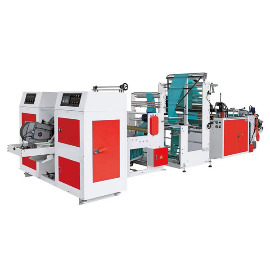
Plastic Bag Making Machine
Film defects: Inclusions (gels, black specks) or scratches can weaken the film, causing breakage at that point. The machine's vision system can detect these defects and slow down or stop before the film breaks. The defects are also logged, and the film supplier is notified. The film's tensile strength can be measured on-line using a non-contact method (e.g., ultrasonic). If the strength drops below a threshold, the machine reduces speed to prevent breakage.
Diagnostic tools: A high-speed video camera can be used to observe the film path during breakage; the footage reveals the exact point and mode of failure. A tension meter with a data logger is used to measure tension at multiple points. The machine's control system provides a "breakage report" that includes the time, speed, tension, and dancer position at the moment of breakage. The report helps in root cause analysis.
Preventive measures: Regularly check the dancer arm's travel range; ensure it has enough stroke to absorb speed variations. Calibrate the unwind brake or servo to ensure it responds rapidly. Use automatic splicing with high-quality tape. Implement a predictive model that anticipates tension spikes based on speed changes and adjusts the brake or pull roller accordingly. By addressing film breakage systematically, bag making machines can achieve higher uptime and reduce material waste.