Bag Making Machine Common Problems Technical Deep Dive: Registration Error and Compensation Algorithms
Registration error – the misalignment between the print mark and the seal/cut position – is a frequent and costly problem in bag making machines. It causes bags with off-center prints, which are often rejected or require expensive rework. The error can be systematic (constant offset) or dynamic (varying with speed). Systematic errors are usually due to sensor misalignment, incorrect cut length setting, or incorrect phase offset. Dynamic errors arise from film slip, stretching, or sensor latency. The registration system uses a photoelectric sensor or a camera to detect a print mark. The time between marks is measured and compared to the expected value. The error is computed as the difference between the actual mark position and the desired position. A PI controller calculates a correction that is applied to the film pull servo as a phase shift. However, at high speeds (200+ BPM), the sensor's response time (typically 0.5-2 ms) and the control loop's update rate can introduce delays, causing oscillation. To address this, the control algorithm uses a model-based predictive approach: it predicts the film's position based on the speed and acceleration, and applies the correction in advance. The algorithm includes a feed-forward term that compensates for the expected film stretch at the current tension. The stretch is estimated from the tension reading and the film's modulus.
Sensor latency and compensation: The sensor's signal is subject to a time delay due to processing. For a camera, the delay can be 5-10 ms. At a film speed of 5 m/s, a 5 ms delay corresponds to a 25 mm error. To compensate, the control system uses a time-based correction: the sensor's position reading is back-calculated to the time when the mark passed the sensor. The system uses a high-resolution encoder on the film pull roller to track the film position accurately. The correction is applied to the cut trigger time, not the position. This is known as a "time-based" registration system. The controller also includes a "deadband" to avoid constant corrections; a correction is only applied if the error exceeds a threshold (e.g., 0.5 mm). The deadband reduces actuator wear. The system can also use a dual-sensor configuration: one sensor for rough registration and one for fine, with the fine sensor having a faster response.
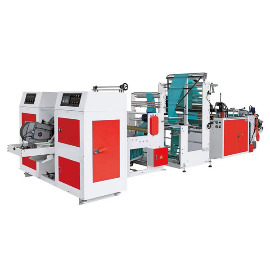
Plastic Bag Making Machine
Film slip and stretch: Film slip occurs when the pull rollers fail to grip the film, causing it to advance less than commanded. This is often due to worn rubber rollers, insufficient nip pressure, or oil contamination. Stretch occurs when the film elongates under tension. Both cause the actual bag length to be longer or shorter than the commanded length. To compensate, the machine uses a slip/stretch model: a speed-dependent correction factor is applied to the commanded length. The factor is learned from historical data: the system compares the commanded length to the actual bag length (measured by a vision system) and adjusts the factor. The correction is updated continuously, using a moving average to smooth noise. For films with high stretch (e.g., LLDPE), the correction factor can be up to 2-3%.
Troubleshooting registration errors: First, check the sensor alignment and cleanliness. Clean the lens and verify the sensor's mounting rigidity. Then, check the film tension; high tension causes stretch, low tension causes slip. Adjust the tension setpoint. Check the pull roller condition; if glazed, replace or clean with a solvent. Verify the registration mark's quality – it should have high contrast and be consistent. If the error persists, check the encoder coupling; a loose coupling causes position drift. Finally, check the control gains – if the PI gains are too high, they can cause oscillation; if too low, they cause slow correction. The machine's control system provides an auto-tuning feature for the registration loop. By understanding and addressing these factors, registration errors can be minimized, ensuring accurate, consistent bag printing and cutting.