Bag Making Machine Cost Analysis: Operating Expenses and Lifecycle Costing
Understanding the operating costs of a bag making machine is essential for accurate budgeting and profitability analysis. The main operating expenses are: energy (electricity), labor, maintenance, consumables (sealing tapes, blades, heaters), and downtime costs. For a typical high-speed machine (250 BPM, 30 kW total power), running 16 hours/day, 5 days/week, 50 weeks/year, the annual energy cost is: 30 kW × 16 h × 5 days × 50 weeks × $0.12/kWh = $14,400. If the machine is servo-driven, energy consumption may be 30% lower, saving $4,300/year. Labor costs: one operator can run 1-2 machines; annual cost $30,000-$50,000 per operator. If the machine has automatic splicing and stacking, one operator can run 3-4 machines, reducing labor cost per machine to $10,000-$15,000. Maintenance: typical annual maintenance cost is 3-5% of the machine's purchase price. For a $100,000 machine, that's $3,000-$5,000/year. This includes routine cleaning, lubrication, calibration, and parts replacement. Consumables: sealing bar tapes ($500/year), blades ($300/year), heaters ($400/year), filters ($200/year). Total consumables ~$1,500/year. Downtime cost: if the machine is down for 2 hours per month due to repairs, at a production rate of 250 BPM and a profit of $0.005/bag, the lost profit is 250 × 60 × 2 × 12 × $0.005 = $1,800/year. If the downtime is 5 hours/month, it's $4,500/year. Preventive maintenance reduces downtime.
Lifecycle costing: Over a 10-year life, the total cost includes initial purchase ($100,000) + energy ($14,400 × 10 = $144,000) + labor ($20,000 × 10 = $200,000) + maintenance ($4,000 × 10 = $40,000) + consumables ($1,500 × 10 = $15,000) + downtime ($3,000 × 10 = $30,000) = $529,000. The machine produces 96 million bags/year × 10 = 960 million bags. Cost per bag = $529,000 / 960M = $0.00055. This is a rough estimate; actual costs vary. The key is to reduce energy (servo drives, insulation), labor (automation), and downtime (predictive maintenance).
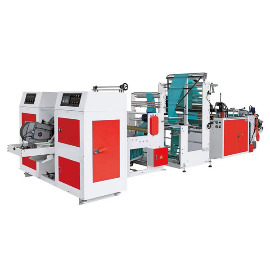
Plastic Bag Making Machine
Energy efficiency improvements: Use servo motors with regenerative braking. Insulate sealing bars to reduce heat loss. Use LED lighting. Install variable frequency drives on cooling fans. Use heat recovery from chillers. These measures can reduce energy cost by 20-30%. Labor cost reduction: automatic splicing, auto stack discharge, and in-line quality control reduce the need for operator intervention. One operator can monitor multiple machines. Maintenance cost reduction: predictive maintenance reduces emergency repairs. Use high-quality consumables that last longer. Downtime reduction: implement a comprehensive maintenance program with spare parts inventory.
Cost per bag calculation: To determine the true cost per bag, include all operating expenses plus the amortized purchase price. For the example above, the annual total cost = purchase price amortized over 10 years ($10,000/year) + energy $14,400 + labor $20,000 + maintenance $4,000 + consumables $1,500 + downtime $3,000 = $52,900/year. Annual production = 96 million bags. Cost per bag = $52,900 / 96M = $0.00055. If the profit margin is $0.002 per bag, the annual profit is $192,000, giving a healthy ROI. By monitoring and optimizing these costs, manufacturers can improve profitability.
Benchmarking: Compare your machine's cost per bag with industry averages. Typical cost per bag for a T-shirt bag is $0.0005-$0.001. If your cost is higher, investigate the root cause – maybe energy consumption is high (check heater power), or labor is high (increase automation), or maintenance is excessive (review spare parts quality). The machine's control system can provide data on energy consumption, reject rate, and downtime. Use this data for continuous improvement. By analyzing and managing operating costs, bag making machine owners can maximize their return on investment and remain competitive in the market.