Bag Making Machine Custom Technical Deep Dive: Engineering Customizations and Feasibility Analysis
Custom bag making machines are designed to meet specific production requirements that standard machines cannot fulfill. The customization process starts with a feasibility analysis: the buyer's requirements are reviewed by the manufacturer's engineering team. The requirements may include: non-standard bag dimensions (e.g., width > 1200 mm), special film materials (e.g., high-barrier laminates), unique bag features (e.g., easy-tear perforations, reinforced handles), unusual production speeds, or integration with existing equipment. The feasibility analysis assesses if the modifications are technically possible within the machine's architecture and budget. The analysis includes: mechanical design (e.g., can the frame accommodate a wider sealing bar?), thermal design (e.g., can the heaters achieve the required temperature for special films?), motion control (e.g., can the servo system handle the required speed and accuracy?), and software (e.g., can the control algorithm be modified for a new feature?). The manufacturer may need to run simulations (FEA, CFD) to validate the modifications. If feasible, the manufacturer provides a cost estimate and a timeline. The buyer may need to adjust their requirements if the feasibility analysis shows limitations.
Design modifications and engineering: Once feasibility is confirmed, detailed design modifications are made. For mechanical changes, CAD models are updated, and new drawings are created. The design must consider the impact on existing components: e.g., a wider sealing bar may require a stronger frame and larger actuators. The new design is analyzed using FEA to check stress and deflection. For thermal changes, the heater placement and power are recalculated. For motion control, the servo sizing and cam profiles are recalculated. The software is modified to include new functions or parameters. The engineering team also updates the documentation (operation manual, maintenance manual) to reflect the changes. The buyer should be involved in the design review to ensure their requirements are met. The design changes are documented in a change log. The manufacturer should also consider the serviceability of the custom machine: can technicians easily access the new components? The design should follow good engineering practices (modularity, standardization). The changes are then prototyped.
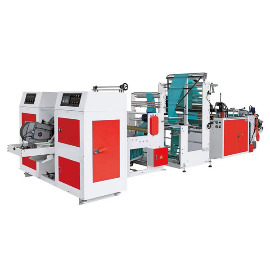
Plastic Bag Making Machine
Prototyping and testing: A prototype or a pilot machine is built to test the customization. The prototype uses the same modifications that will be in the final production machine. The prototype is run with the buyer's film and bag design. The testing verifies: speed, bag quality, seal strength, and reliability. The test results are compared to the requirements. If any issues are found, the design is iterated. The testing may also include accelerated life testing to assess durability. The prototype phase is critical; it allows the buyer to see the custom features in action and suggest final adjustments. The prototype test is documented and approved. After prototype approval, the manufacturer proceeds with production of the custom machines. The buyer may need to accept a longer lead time for custom machines.
Cost and lead time considerations: Custom machines are more expensive due to engineering effort, custom parts, and longer testing. The cost increase is typically 30-100% above a standard machine. The lead time is also longer, usually 4-8 months instead of 2-3 months. The buyer should evaluate if the custom features justify the extra cost and time. In some cases, a compromise is possible – using standard modules with minor modifications. The buyer should also consider the availability of replacement parts: custom parts may have longer lead times. The manufacturer should provide a list of custom parts and their sourcing. The buyer should also consider the resale value of a custom machine; it may be harder to sell because it is tailored to specific needs. However, for a unique application, a custom machine is the only solution. By following a structured engineering and validation process, buyers can obtain a bag making machine that precisely fits their production needs, maximizing efficiency and product quality.