Bag Making Machine Cutting Technical Deep Dive: Guillotine Cutter Dynamics and Synchronization
The guillotine cutter is used in bag making machines for intermittent cutting of thicker films and heavier materials. It consists of a straight blade that moves vertically (or diagonally) against a fixed anvil. The blade is driven by a servo motor with a crank mechanism or by a pneumatic cylinder. The blade's motion profile is critical: it must accelerate, reach the cutting speed, decelerate, and return. The cutting speed (the blade's vertical speed) must be high enough to shear the film cleanly; typically 0.5-1 m/s. The cutting force is determined by the film's shear strength and thickness. The crank mechanism converts rotary motion to linear; the crank radius and connecting rod length determine the stroke. The servo motor provides precise control of the blade's position and speed. The blade's position is measured by an encoder. The cutting cycle is synchronized with the film feed: the blade cuts when the film is stopped. The cut timing is controlled by the registration sensor; the blade is triggered when the film has reached the correct length. The cut must be completed before the next film feed starts. The guillotine cutter is noisier and produces more vibration than rotary cutters; the machine's frame must be rigid to absorb the impact. The blade's guide system must be lubricated to reduce friction. The blade's angle (typically 1-3 degrees) reduces the required force. The blade clearance to the anvil is 0.02-0.05 mm.
Dynamics of the guillotine: The blade's motion is governed by the servo motor's torque and the load inertia. The motor must accelerate the blade mass (typically 5-15 kg) from rest to cutting speed within 20-30 ms. The motor's torque must overcome the inertia and the cutting force. The cutting force is approximately F = Shear Strength × Area = τ × (bag width × thickness). For a 1m wide, 100-micron LDPE film, τ=10 MPa, F = 10e6 × 1 × 0.0001 = 1000 N. The motor's power is F × speed / efficiency. The acceleration profile is S-curved to reduce jerk. The blade's return stroke is faster to minimize cycle time. The controller uses a position loop to ensure the blade stops exactly at the anvil; any overshoot causes blade damage. The blade's position error is monitored; if it exceeds 0.1 mm, the machine stops. The vibration from the cutting is damped by the machine's frame and vibration mounts. The cutting force is also influenced by the blade's sharpness; a dull blade increases the force and may cause the motor to overload. The motor's current is monitored; an increase indicates blade dulling. The guillotine cutter is often used for sack machines and heavy-duty applications.
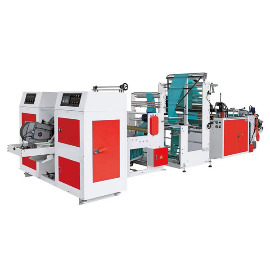
Plastic Bag Making Machine
Synchronization with film feed: The guillotine's timing is derived from the registration sensor. When the film feed servo completes its motion, it sends a "ready" signal to the cutter. The cutter then initiates its motion. The total time for cutting is 50-100 ms. The machine's control system must ensure that the film is completely stopped and stable before the cut. The film's settling time depends on the film's elasticity and the tension control. The settling time is minimized by using a high-gain position loop and a fast servo. The synchronization is tested at the FAT; the cut length variation should be within ±0.5 mm. The machine's control system also compensates for the film's thermal expansion by adjusting the cut timing. The guillotine cutter can also be used in a "flying" mode, where the blade moves with the film during the cut; this is more complex but allows higher speeds. The flying guillotine requires the blade to match the film speed at the moment of cut, adding an extra servo axis.
Maintenance: The guillotine blade must be sharpened regularly; a dull blade causes ragged cuts and increased force. The blade's clearance is checked with a feeler gauge and adjusted. The blade's guide system is lubricated; the guide rails are inspected for wear. The crank mechanism's bearings are lubricated. The anvil is inspected for wear; a worn anvil causes uneven cuts. The cutting station's dust extraction is cleaned. The guillotine cutter is reliable but requires more maintenance than rotary cutters. By understanding the dynamics and synchronization, operators can optimize the guillotine cutter for high-quality, precise cuts in heavy-duty applications.