Bag Making Machine Cutting Technical Deep Dive: Rotary Knife Design and Wear Analysis
The rotary knife is a critical component in high-speed bag making machines, responsible for separating the film into individual bags with clean, straight edges. The rotary knife consists of a cylindrical blade (helical or straight) that rotates against an anvil roller. The blade's edge geometry is typically a bevel angle of 20-30 degrees, with a sharp edge radius of <0.01 mm. The blade material is high-speed steel (HSS) or tungsten carbide; carbide offers 5-10 times longer life but is more expensive. The anvil roller is made of hardened steel (HRC 55-60) or polyurethane. The gap between the blade and anvil is set to 0.01-0.03 mm; this gap is critical – too large causes incomplete cuts, too small causes blade wear. The blade's peripheral speed must match the film speed to avoid dragging. The blade is driven by a servo motor with a position feedback encoder. The blade's life is typically 5-20 million cuts, depending on the film's abrasiveness. The wear mechanisms include: 1) Abrasive wear from film fillers (e.g., titanium dioxide, chalk). 2) Adhesive wear from film polymer sticking. 3) Fatigue wear from cyclic loading. The wear causes the blade's edge to dull, increasing the cutting force and producing ragged cuts. The blade wear is monitored by measuring the motor current – an increase of 10-20% indicates dulling.
Anvil wear: The anvil roller also wears; the surface becomes grooved or flat-spotted. A worn anvil causes uneven cutting and blade wear. The anvil is typically reground every 5-10 million cuts. The anvil's hardness is matched to the blade; a softer anvil (polyurethane) is used for thinner films to reduce blade wear, but it wears out faster. A steel anvil is used for thicker films but requires precise gap control. The anvil's alignment with the blade is checked regularly; any skew causes uneven cutting. The blade and anvil are lubricated with a small amount of oil or dry lubricant to reduce wear and prevent film sticking. The cutting process generates dust; a vacuum extraction system removes it. The dust can contaminate the film and affect sealing. The cutting station also includes a film hold-down system (air or mechanical) to prevent film flutter during cutting.
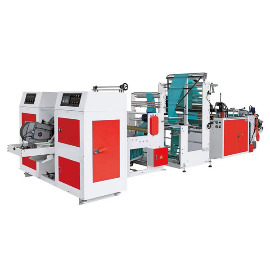
Plastic Bag Making Machine
Cut quality assessment: The cut quality is inspected by vision – the edge should be straight, without burrs or feathering. The cut width is measured; if it varies, the blade or anvil may be worn. The cut quality is also assessed by the bag's appearance – any jagged edges are rejected. The machine's control system can automatically adjust the blade gap if the cut quality degrades; this is done by a servo-driven adjustment mechanism. The adjustment is based on the cutting force measured by a load cell. The cutting force is also used to detect film thickness variations; a thicker film requires a higher force, and the machine can adjust the gap accordingly. The cutting station is calibrated using a reference film with known thickness. The blade's life is tracked by a counter; when the count reaches the limit, the machine alerts for blade replacement. The blade replacement is a scheduled maintenance task, taking 10-15 minutes.
Advanced cutting technologies: Some machines use a laser cutting system, which is contactless and eliminates wear, but is slower and more expensive. Laser cutting is used for specialty films (e.g., high-barrier laminates). Another technology is the "flying knife" – a servo-driven blade that moves with the film during the cut, allowing continuous operation without stopping the film. This increases speed by 10-15% but requires complex synchronization. The flying knife is used in high-end machines. The buyer should evaluate the cutting system's maintenance requirements and the cost of spare blades and anvils. A system with easy blade change and quick-gap adjustment reduces downtime. By optimizing rotary knife design and managing wear, bag making machines achieve clean, precise cuts, essential for bag integrity and customer satisfaction.