Bag Making Machine Efficiency Technical Deep Dive: Energy Consumption Optimization and Heat Recovery
Energy efficiency is a critical factor in the operating cost and environmental footprint of a bag making machine. The primary energy consumers are the sealing heaters (40-60% of total power), servo motors (20-30%), and auxiliary systems (cooling fans, compressors, conveyors). To improve efficiency, the first step is to reduce heat loss from the sealing bars. Insulating the bars with ceramic or aerogel blankets reduces heat loss by 20-30%. The insulation is placed around the heaters and on the back of the bar. The bar's operating temperature is also optimized; running at the lowest temperature that still provides adequate seal strength reduces energy consumption. The temperature reduction is achieved by using high-quality film with a wide sealing window. The controller's PID tuning also affects efficiency; a well-tuned controller minimizes heater power fluctuations. The use of variable frequency drives (VFDs) on cooling fans and pumps reduces auxiliary energy. The cooling fans are only run when needed; the VFD adjusts the speed based on the temperature. The chill roller's refrigeration system is a significant energy consumer; using a water-cooled system with a chiller that has a high coefficient of performance (COP) reduces energy. The chiller's setpoint is optimized; a 1°C increase in setpoint reduces energy consumption by 3-5%.
Regenerative braking: Servo motors in bag making machines generate regenerative energy during deceleration. In traditional systems, this energy is dissipated as heat in braking resistors. In modern systems, the regenerative energy is fed back to the main power supply via an active front end (AFE) or stored in a capacitor bank. The AFE converts the DC bus voltage back to AC and synchronizes it with the mains, achieving near-unity power factor and reducing harmonics. The regenerative energy can save 10-15% of the total energy consumption. The regenerative system's efficiency is affected by the load profile; high deceleration rates generate more regenerative energy. The machine's motion profile is optimized to maximize regenerative energy recovery; a smoother deceleration reduces energy recovery but also reduces mechanical stress. The regenerative system also includes a braking resistor as a backup; the resistor is sized for the maximum regenerative power. The regenerative energy can also be used to power other axes (e.g., one axis decelerating while another accelerates) if the drives share a common DC bus. The common DC bus architecture is common in high-end machines and can save an additional 5-10%.
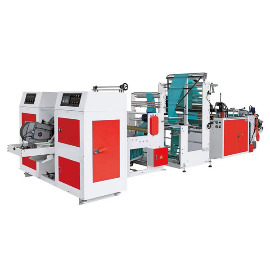
Plastic Bag Making Machine
Heat recovery: The heat generated by the sealing bars, chill rollers, and servo drives can be recovered and used for space heating or preheating the film. For example, the cooling water from the chill rollers (at 30-40°C) can be used to preheat the film before sealing, reducing the required heater power. A heat exchanger transfers the heat from the water to the film. The recovered heat can also be used to heat the plant's offices or warehouses during winter. The heat recovery system is more cost-effective in colder climates. The heat recovery efficiency depends on the temperature difference and the heat exchanger's design. A plate heat exchanger with a high heat transfer coefficient is used. The recovered heat can reduce the machine's overall energy consumption by 5-10%. The energy consumption of the machine is monitored by a power meter; the data is logged and displayed on the HMI. The operator can see the energy per thousand bags (kWh/1000 bags) and compare it to benchmarks. If the energy consumption increases, the operator can investigate the cause (e.g., heater degradation, insulation damage).
Efficiency benchmarking: The buyer should compare the machine's energy efficiency with industry benchmarks. A typical servo-driven bag making machine consumes 10-20 kWh per 1000 bags; older clutch-brake machines consume 25-40 kWh per 1000 bags. The buyer should request the machine's energy consumption data from the supplier. The machine's control system can also calculate the specific energy consumption (SEC) per bag. The SEC is used for carbon footprint reporting. The buyer can also optimize the production schedule to run the machine during off-peak electricity hours, reducing the energy cost (if the utility has time-of-use rates). By implementing energy optimization strategies, bag making machines can achieve significant cost savings and reduce their environmental impact, contributing to sustainability goals.