Bag Making Machine Factory Technical Deep Dive: Testing and Run-In Procedures for Quality Assurance
Testing is the final and most critical stage of bag making machine production. A comprehensive testing protocol ensures that the machine meets all specifications before it leaves the factory. The testing process is divided into sub-assembly testing, final assembly testing, and run-in testing. Sub-assembly testing is performed on individual modules: the unwind stand is tested for brake function and tension control; the sealing unit is tested for temperature uniformity and pneumatic/hydraulic actuation; the cutter is tested for sharpness and alignment; the punch unit is tested for die clearance and cycle time; the stacking unit is tested for conveyor speed and counting accuracy. Each sub-assembly is run separately to verify its functionality. The electrical panel is tested for power supply, I/O signals, and communication with the HMI. The motion controller is tested with a simulated load to ensure servo axes move correctly. Any sub-assembly that fails is reworked and re-tested. After sub-assemblies pass, they are integrated into the main machine. The final assembly testing includes a full mechanical and electrical check: all bolts are torqued, all connections are verified, and all safety interlocks are tested. The machine is powered up, and the PLC program is loaded. A dry run (without film) is performed to check all axes' motion profiles, timing, and alarms. The safety circuit is tested by triggering emergency stops and light curtains.
Run-in procedure: The run-in is a continuous test with actual film, simulating production conditions. The machine is loaded with a film roll and run at 50% speed for 30 minutes, then 75% for 30 minutes, and finally 100% for 2-4 hours. During the run-in, the following parameters are monitored: sealing temperature (stability and uniformity), bag length (consistency), registration accuracy, seal strength (samples are taken and tested), stack quality, and any alarms. The machine's vibration and noise levels are measured. The run-in is also used to "break in" the mechanical components, reducing friction and settling the bearings. Any adjustments (e.g., temperature fine-tuning, roller alignment) are made during the run-in. After the run-in, the machine is inspected for any leaks, loose fasteners, and wear signs. The run-in results are documented. The machine is then prepared for the Factory Acceptance Test (FAT).
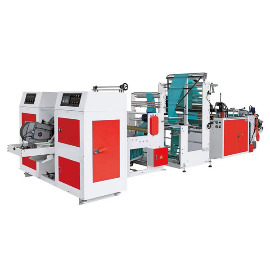
Plastic Bag Making Machine
Factory Acceptance Test (FAT): The FAT is a formal test witnessed by the buyer (or their representative). The buyer brings their own film and bag design. The test protocol is agreed upon in the contract. The machine is run at the agreed speed, and bags are sampled at regular intervals. The samples are measured for dimensions, seal strength (peel test), and registration. The machine's performance is compared to the specification. The reject rate and waste are recorded. The FAT also includes a demonstration of all functions: printing, punching, zipper application, stacking, and bundling. The machine's safety features are demonstrated. If the machine meets all criteria, the buyer signs the FAT approval. If not, the manufacturer makes corrections and re-tests. The FAT report is a key document for the final payment.
Testing equipment and calibration: The factory should have calibrated testing equipment: thermocouple calibrators, pressure gauges, force gauges, rulers, peel testers, and vibration meters. The equipment is calibrated regularly, with traceability to national standards. The testing area should be temperature-controlled to ensure consistent results. The factory should also have a method for testing the machine's electrical safety (insulation resistance, hi-pot) and EMC (if required). The test results are logged and stored in the machine's history file. By implementing rigorous testing and run-in procedures, bag making machine factories ensure that each machine is reliable, performs as promised, and is ready for immediate production upon installation, reducing commissioning time and early-life failures.