Bag Making Machine Film Feeding Technical Deep Dive: Dancer Arm Dynamics and Tension Control Modeling
The dancer arm is a critical component of the film feeding system in bag making machines, acting as a mechanical buffer and tension sensor. It consists of a free-floating roller mounted on a pivoting arm, with a spring or air cylinder providing a reference force. The film wraps around the dancer roller, and the arm's position changes as the film tension varies. The position is measured by a potentiometer or encoder. The dancer arm dynamics can be modeled as a mass-spring-damper system: J * d²θ/dt² + b * dθ/dt + k * θ = T_film * R + M_gravity, where J is the arm's moment of inertia, b is the damping coefficient, k is the spring stiffness, θ is the arm angle, T_film is the film tension, R is the roller radius, and M_gravity is the gravitational torque. The system's natural frequency is ω_n = sqrt(k/J) and damping ratio ζ = b / (2*sqrt(k*J)). For optimal performance, the natural frequency should be at least 5-10 times the machine's cycle frequency to avoid resonance. The damping ratio should be around 0.7 for critical damping. The controller adjusts the unwind brake or motor torque to maintain the dancer arm at a setpoint position, which corresponds to the desired tension. The tension is related to the dancer force: Tension = (Spring Force + Air Pressure Force - Inertia Forces) / (2 * roller wrap angle). The tension setpoint is typically 10-30 N for LDPE.
PID tuning for tension control: The tension controller is a PID (Proportional-Integral-Derivative) loop. The process variable is the dancer position (or load cell signal), and the output is the unwind torque or brake current. The PID gains are tuned using the Ziegler-Nichols method or by analytical calculation based on the system's transfer function. The plant transfer function includes the dancer dynamics and the unwind motor response. For a servo-driven unwind, the motor's time constant (τ) and gain (K) are known. The closed-loop bandwidth should be high enough to reject disturbances from the pull rollers. The integral gain is set to eliminate steady-state error, but too high causes oscillation. The derivative gain adds damping. The controller also includes a feed-forward term that anticipates the pull roller speed change and adjusts the unwind torque accordingly. This reduces the phase lag. The tension control performance is measured by the tension variation (typically <±2% of setpoint). The tension variation is influenced by the dancer arm inertia; a lighter arm improves responsiveness. Some machines use a load cell instead of a dancer for more direct tension measurement. The load cell provides a faster response but lacks the buffering capability of a dancer. A combination of both is used in some high-end machines.
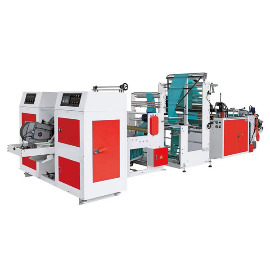
Plastic Bag Making Machine
Disturbance rejection: The main disturbances are: 1) Film roll eccentricity – causes periodic tension variations at the roll's rotation frequency. This can be compensated by an adaptive notch filter in the controller. 2) Film thickness variations – cause changes in the film's stiffness, affecting tension. 3) Pull roller acceleration – causes a tension spike; feed-forward compensation is used. 4) Splices – cause a temporary tension change; the controller must recover quickly. The control algorithm includes an anti-windup mechanism to prevent integral saturation during large disturbances. The controller's output is limited to the motor's maximum torque. The tension data is logged and analyzed; a gradual increase in tension may indicate bearing wear or film quality degradation. By understanding and optimizing dancer arm dynamics and tension control, bag making machines achieve stable film feeding, preventing wrinkles and improving bag quality.