Bag Making Machine Film Feeding Technical Deep Dive: Edge Guide Systems and Compensation Algorithms
Edge guide systems ensure that the film remains centered in the bag making machine, preventing wandering that causes mis-seals and scrap. The edge guide uses a sensor (ultrasonic, optical, or laser) to detect the film edge or a printed line. The sensor output is fed to a controller that drives a steering roller or a lateral shift mechanism. The system has a deadband to avoid constant corrections; the deadband is typically ±0.5 mm. The sensor's resolution is 0.01-0.1 mm. The actuator is a servo motor or pneumatic cylinder with a position feedback encoder. The controller uses a PI algorithm to maintain the film edge at the setpoint. The actuator response time is critical: for high-speed machines, the actuator must correct deviations within 10-20 ms. The steering roller is mounted on a pivot; its angle is adjusted to steer the film. The steering geometry is such that the film follows the roller's normal. The system must be tuned to avoid overshoot and oscillation. The film edge position is also affected by tension changes; the controller should be decoupled from the tension controller. The edge guide system can be used with an auto-splicing system – during a splice, the edge may wander; the guide quickly re-centers the film.
Sensor fusion: To improve reliability, some machines use multiple sensors – e.g., two edge sensors (one on each side) and a line guide. The sensor fusion algorithm combines the readings using a Kalman filter to estimate the true film center. The Kalman filter accounts for sensor noise and process noise. If one sensor fails, the system can rely on the other. The line guide is used for printed films where the edge may be irregular; the line guide detects a printed line that is consistently positioned relative to the print. The line guide is an optical sensor that detects contrast. The edge guide system can also use a camera-based sensor that images a wider area and calculates the film position using image processing. This is more expensive but provides more information. The camera can also detect film wrinkles or defects. The sensor fusion algorithm also compensates for the film's thermal expansion – the film's width changes with temperature, affecting the edge position. The temperature sensor data is used to adjust the setpoint.
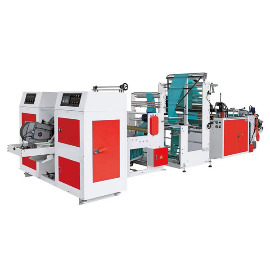
Plastic Bag Making Machine
Compensation algorithms: The controller includes algorithms to compensate for: 1) Roll runout – the film roll may not be perfectly round, causing a periodic edge shift. The algorithm uses a learning control that stores the correction profile for each revolution. 2) Film thickness variations – cause the film to wander; the algorithm adjusts the guide based on the thickness gauge data. 3) Splice – causes a sudden edge shift; the algorithm predicts the splice (based on a splice mark) and applies a preemptive correction. The compensation algorithms are adaptive – they learn from the film's behavior over time. The edge guide system also has a diagnostic mode that logs the actuator position and sensor readings. The data can be used to diagnose wear in the steering mechanism. The edge guide's precision directly affects the bag's width and print alignment; a well-tuned edge guide reduces waste by 1-2%.
Maintenance and calibration: The edge guide sensor must be cleaned regularly – dust or film residue can affect accuracy. The sensor's alignment is checked using a calibration jig. The actuator's backlash is measured and compensated in the software. The steering roller's bearings are lubricated per schedule. The edge guide's performance is tested by running a film with a known deviation and measuring the correction. A poorly tuned edge guide can cause a "hunting" oscillation; the PI gains are adjusted to reduce it. By implementing robust edge guide systems and compensation algorithms, bag making machines maintain precise film positioning, ensuring consistent bag dimensions and minimizing waste.