Bag Making Machine Folding Technical Deep Dive: Bottom Fold Formation and Square Bottom Creasing
Square bottom bags (block bottom) require a complex folding sequence to create a flat, rectangular base. The folding process involves multiple steps: first, the film is creased along predefined lines; then, the bottom flaps are folded in a specific order (typically side flaps first, then end flaps); finally, the flaps are sealed or glued. The crease geometry is critical: the crease lines must be precisely positioned and angled to produce a symmetrical bottom. The crease angles are typically 45 degrees for the diagonal folds. The crease depth is controlled by a creasing roller or a set of creasing plates. The crease must be deep enough to guide the fold but not so deep that it weakens the film. The folding sequence is driven by a series of servo-controlled tucking blades and folding plates. The tucking blades push the film into the folding plates, creating the folds. The tucking blades are made of hardened steel with a polished surface. The folding plates are adjustable for different bottom depths and bag widths. The folding station also includes a hot melt adhesive applicator that applies glue to the flaps before they are pressed. The adhesive amount is controlled by a positive displacement pump. After folding, the bottom is pressed by a heated platen (5-10 bar, 120-150°C) to set the adhesive and flatten the bottom. The press dwell time is 0.5-1.5 seconds.
The bottom folding sequence is critical for bag stability. The sequence is: 1) Pre-crease the film along the bottom lines. 2) Fold the side flaps inward. 3) Fold the end flaps over the side flaps. 4) Apply adhesive to the end flaps. 5) Press the bottom. The timing of each step is controlled by the machine's PLC; the film is stopped during the folding sequence. The total folding time is 1-2 seconds, which limits the machine's speed to 30-60 BPM for square bottom bags. To increase speed, some machines use a rotary turret with multiple stations operating in parallel. The turret rotates, with each station performing a different folding step. The turret design allows overlapping operations, reducing the cycle time. The turret's indexing mechanism is servo-driven for precise positioning. The folding stations on the turret are modular, allowing quick changeover for different bottom sizes. The bottom folding station also includes a vision system that inspects the bottom symmetry and fold alignment. If a mis-fold is detected, the machine rejects the bag. The folding station's performance is validated by measuring the bottom flatness – the bag is placed on a flat surface, and the gap under the bottom is measured with a feeler gauge. The gap should be less than 0.5 mm.
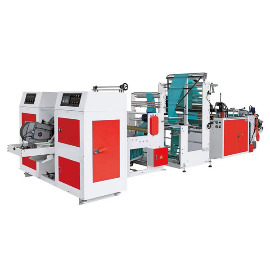
Plastic Bag Making Machine
Adhesive integration: The adhesive is applied to the flaps just before folding. The adhesive applicator uses a nozzle or a slot die to apply a thin, uniform bead of hot melt. The adhesive temperature and pressure are controlled to ensure consistent application. The adhesive pattern is designed to cover the entire flap area without excess that could ooze out. The adhesive's open time (the time before it sets) must match the folding and pressing time. For hot melt, the open time is typically 1-3 seconds. The adhesive is applied by a servo-controlled applicator that moves with the film. The applicator's position is adjusted for different bag sizes. The adhesive weight is monitored by a flow meter; a deviation triggers an alarm. The adhesive is also checked for contamination. The pressing station's heated platen has a contour that matches the bottom shape, ensuring even pressure. The platen's temperature is controlled to optimize the adhesive bond. After pressing, the bottom is cooled by a chill plate to solidify the adhesive. The bottom seal strength is tested by a burst test; the burst pressure should exceed the product's weight. The folding station is maintained by cleaning the folding plates and adhesive nozzles daily. The platen is checked for flatness and temperature uniformity. By mastering bottom fold formation and creasing, bag making machines produce stable, self-standing bags that are ideal for coffee, pet food, and other premium products.