Bag Making Machine Folding Technical Deep Dive: Gusset Former Geometry and Film Deformation Mechanics
The folding section of a bag making machine is responsible for creating side gussets, bottom folds, and other geometric features that determine the bag's final shape and volume. The gusset former is the most critical component, consisting of a series of folding plates and forming boards that progressively bend the film along predetermined lines. The geometry of the folding plates – their angles, radii, and relative positions – directly influences the gusset depth, symmetry, and wrinkle formation. The film's deformation during folding is governed by its bending stiffness (flexural modulus) and thickness. For LDPE film with a modulus of 200-300 MPa and thickness of 50 microns, the bending stiffness is relatively low, allowing easy folding. However, for stiffer films like HDPE or laminates, the bending stiffness is higher, requiring sharper creasing and higher pressure to set the fold. The folding plates are designed with a gradual transition angle – typically 15-30 degrees – to avoid sharp bends that cause stress whitening or cracking. The plates are polished to a mirror finish (Ra 0.4 μm) and coated with low-friction materials (PTFE or DLC) to reduce drag. The gap between the folding plates is adjustable to accommodate different film thicknesses; the gap is typically set to 1.5-2 times the film thickness.
The folding process involves both bending and compression. As the film passes through the folding plates, it is bent around the plate edges, creating a crease. The crease is then set by a heated creasing roller (50-80°C) that applies pressure (2-5 bar) to permanently deform the film. The crease depth is controlled by the roller's gap and temperature. The crease must be deep enough to retain the fold but not so deep that it weakens the film. The crease quality is assessed by measuring the fold retention angle – the angle at which the folded gusset springs back. A good fold has a retention angle of less than 5 degrees. The folding station also includes a set of guide rollers that maintain the film's tension and alignment. The tension in the folding section must be lower than in the sealing section to allow the film to bend freely; typically 5-10 N. The folding station is often a separate module that can be removed for maintenance or changeover.
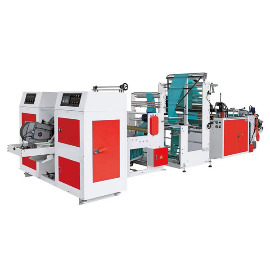
Plastic Bag Making Machine
Simulation of folding: Finite element analysis (FEA) is used to simulate the film's deformation during folding. The film is modeled as a hyperelastic material with anisotropic properties (due to the orientation from extrusion). The simulation predicts the stress and strain distribution, identifying areas of high stress that may cause wrinkles or tearing. The simulation also predicts the crease's spring-back behavior. The FEA results are used to optimize the folding plate geometry and the creasing roller's pressure and temperature. For example, if the simulation shows high stress at the fold apex, the plate radius is increased to reduce stress concentration. The simulation is validated by experimental measurements (strain gauges, optical strain mapping). The FEA model is also used to predict the folding behavior of new films, reducing the need for trial-and-error. The machine's control system can store the optimal folding parameters (plate position, creaser temperature, pressure) for each film type.
Troubleshooting folding defects: Common folding defects include: 1) Asymmetrical gussets – caused by misaligned folding plates or uneven tension; the plates are aligned using a dial indicator. 2) Wrinkles at the fold – caused by excessive tension or sharp plate edges; the tension is reduced, or the plates are polished. 3) Gusset not staying flat – insufficient creasing pressure or temperature; the creaser pressure or temperature is increased. 4) Film cracking – crease too deep or film too brittle; the crease depth is reduced, or the film is preheated. The folding station's performance is monitored by a vision system that measures the gusset depth and symmetry. If a defect is detected, the machine can automatically adjust the folding plate position or the creaser parameters. The folding station is also cleaned regularly – any residue on the plates causes film sticking and mis-folds. By optimizing gusset former geometry and understanding film deformation mechanics, bag making machines produce crisp, symmetrical folds that enhance bag appearance and volume capacity.