Bag Making Machine Heat Sealing Technical Deep Dive: Thermal Dynamics and Heat Transfer Modeling
The heat sealing process in bag making machines involves transient heat transfer from the heated sealing bar to the film, followed by conduction through the film layers. A thermal model is essential for predicting the seal temperature and optimizing the parameters. The model considers: 1) Heat generation in the heater (I²R). 2) Conduction through the bar material (copper/aluminum). 3) Contact resistance at the bar-film interface (affected by pressure and coating). 4) Conduction through the film (sealant layer, barrier layer). 5) Convection and radiation losses from the bar to the environment. The heat equation is solved using finite element analysis (FEA) or lumped-parameter models. A lumped model approximates the bar as a thermal capacitance with a heat source and a thermal resistance to the film. The film's temperature rise is governed by: T_film(t) = T_bar - (T_bar - T_initial) * exp(-t/τ), where τ is the thermal time constant, determined by the film's thermal diffusivity and thickness. For a 50-micron LDPE film, τ is about 0.1-0.2 seconds. The seal is formed when the film interface temperature reaches the melting point (typically 120-160°C). The model predicts the required dwell time for a given bar temperature. The model also predicts the temperature distribution across the seal width; a non-uniform distribution causes weak spots. The model is validated by thermocouple measurements on a test setup.
Optimization using the model: The model can be used to optimize the bar temperature and dwell time for a given film and speed. The objective is to maximize seal strength while minimizing energy consumption and avoiding burn-through. The model calculates the seal strength based on the time-temperature history, using the Arrhenius equation for polymer diffusion. The model also accounts for the film's thermal degradation – if the temperature exceeds the degradation threshold (e.g., 200°C for LDPE), the seal is weakened. The model is used in the machine's control system to calculate the required temperature for the current speed – a feed-forward control. The model parameters (film thermal properties) are stored in the recipe. The model is updated with data from the in-line seal tester to refine its accuracy. The model also helps in selecting the bar material – copper provides faster thermal response but is heavier; aluminum is lighter but slower. The model is used in the design phase to size the heaters and the bar's thermal mass.
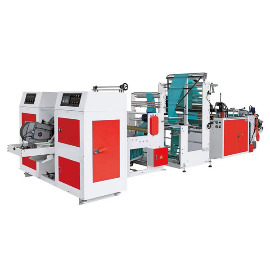
Plastic Bag Making Machine
Cooling dynamics: After sealing, the film must be cooled to solidify the bond. The cooling process is modeled similarly: heat is extracted by a chill roller, and the film cools by conduction and convection. The cooling rate affects the crystallinity of the polymer; slower cooling gives higher crystallinity and stronger seals but requires longer cooling time. The model predicts the cooling time needed to reach a safe temperature (e.g., below 80°C) before the film is handled. The chill roller temperature and speed are optimized using the model. The model also predicts the thermal stress in the film due to shrinkage; excessive shrinkage causes wrinkles. The cooling model is integrated with the sealing model for a complete thermal profile. The model is validated by measuring the film temperature after sealing using an IR camera. The model parameters are adjusted to match the measurements.
Practical application: The thermal model is implemented in the machine's control system. The operator inputs the film type and thickness; the system automatically calculates the optimal temperature, dwell, and chill roller settings. The system also monitors the actual temperature and adjusts the heater power to maintain the setpoint. The thermal model also helps in troubleshooting – if seal defects occur, the model can diagnose if the temperature is too low or too high, or if the dwell is insufficient. The model is also used for predictive maintenance – if the heater's response time slows, the model indicates a failing heater. By using thermal modeling, bag making machines achieve consistent, strong seals with minimal energy consumption and reduced waste.