Bag Making Machine Installation Technical Deep Dive: Precision Leveling and Foundation Anchoring
Precision leveling is the most critical step in bag making machine installation, as any deviation from flatness and parallelism directly affects seal quality, bag length accuracy, and bearing life. The machine's frame is typically mounted on a concrete foundation with anchor bolts or on vibration-damping pads. Before installation, the foundation must be checked for flatness using a laser level; the surface should be within ±0.5 mm over 2 meters. The anchor bolts are placed according to the foundation drawing, with the bolt holes grouted with non-shrink epoxy. The machine is lowered onto the bolts using a crane, and the leveling feet are adjusted. The leveling process uses a precision spirit level (0.02 mm/m accuracy) or a laser level placed on the machine's main beams. The machine is leveled in both longitudinal and transverse directions. The leveling feet are adjusted until the bubble is centered; the process is repeated across multiple points. The machine is also checked for twist: the difference between the diagonals should be less than 0.5 mm. After leveling, the anchor bolts are tightened to the specified torque (typically 100-200 Nm) in a cross pattern. The torque wrench must be calibrated. The leveling is rechecked after the bolts are tightened. The machine's guide rollers and sealing bars are then aligned using a dial indicator; the sealing bars must be parallel to the film path within 0.05 mm. The alignment is critical for uniform pressure distribution.
Vibration isolation: Bag making machines generate significant vibration, especially at high speeds. The vibration can cause misalignment, seal defects, and excessive noise. The machine is mounted on vibration-damping pads (rubber or spring isolators) to isolate the vibration from the floor. The pads are selected based on the machine's weight and the expected vibration frequency. The natural frequency of the isolation system should be below the machine's operating frequency to avoid resonance. The isolators are placed under the machine's feet, and the leveling is done on top of the isolators. The isolators are checked for compression; all isolators should be compressed equally. The machine's vibration is measured using an accelerometer; the vibration velocity should be below 2 mm/s RMS. If the vibration is higher, the isolators may need to be adjusted or replaced. The machine's frame is also stiffened with cross-braces to reduce vibration. The foundation's mass should be at least 3-5 times the machine's mass to provide inertia. The foundation is reinforced with rebar to prevent cracking. The installation area should be isolated from other machinery to prevent cross-vibration.
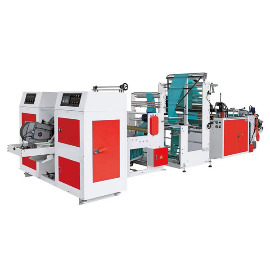
Plastic Bag Making Machine
Utility connections: After leveling and anchoring, the machine is connected to utilities: electrical supply, compressed air, and cooling water. The electrical supply must match the machine's voltage, phase, and frequency. The cable is sized for the machine's maximum current draw. A main disconnect switch and a circuit breaker are installed. The electrical connection is checked for correct phase sequence; incorrect sequence can damage the servo drives. The compressed air line is connected with an inline filter (5 microns), a regulator, and a lubricator (if required). The air pressure is set to the machine's specification (typically 6-8 bar). The cooling water lines are connected with shut-off valves and a flow meter. The water temperature and flow rate are verified. All connections are checked for leaks. The machine's grounding is verified (resistance <1 ohm). The utility connections are documented in the installation report. The machine is then powered up and the PLC is initialized. The machine's parameters are loaded from a backup.
Installation checklist: 1) Foundation flatness verified. 2) Anchor bolts installed and torqued. 3) Leveling completed (within 0.5 mm). 4) Twist checked (diagonal difference <0.5 mm). 5) Vibration isolators installed and compressed. 6) Alignment of guide rollers and sealing bars checked. 7) Electrical connections verified (phase, voltage, grounding). 8) Compressed air and cooling water connected and tested. 9) Machine powered up and parameters loaded. 10) Safety interlocks tested. The installation is typically performed by the supplier's technician or a certified installer. The buyer should have a site supervisor to coordinate the work. The installation takes 2-5 days for a standard machine. By following a meticulous installation procedure, buyers ensure that the bag making machine operates at its full potential, with consistent quality and long service life.