Bag Making Machine Maintenance Technical Deep Dive: Calibration and Alignment Procedures for Precision
Regular calibration of sensors and alignment of mechanical components are essential for maintaining bag quality and machine accuracy. Temperature sensors (thermocouples) are prone to drift; a drift of 2-3°C can cause weak seals or burn-through. Calibration is performed by comparing the thermocouple reading against a certified reference thermometer (e.g., a Pt100 with a calibration certificate). The reference thermometer is inserted into a dedicated calibration hole in the sealing bar. The bar is heated to the setpoint, and after stabilization, the readings are recorded. If the deviation exceeds ±1°C, the controller's offset is adjusted. This procedure is recommended monthly for high-speed machines. Pressure transducers (for pneumatic or hydraulic systems) are calibrated using a reference pressure gauge. The transducer's output (voltage or current) is compared to the reference at multiple points (e.g., 0, 50%, 100% of range). The calibration curve is adjusted if the error exceeds 1%. Load cells used for tension control are calibrated by hanging known weights on the film path; the cell's output is adjusted to match the weight. This is done quarterly. The edge guide sensor (ultrasonic or optical) is calibrated by moving a reference edge (a metal plate) through its sensing range; the sensor's output is checked for linearity and offset.
Mechanical alignment: The sealing bars must be parallel to each other and to the film path. Misalignment causes uneven pressure and seal defects. Parallelism is checked using a dial indicator mounted on a carriage that traverses the bar length. The indicator measures the gap between the upper and lower bars at multiple points; the maximum deviation should be less than 0.05 mm. If misaligned, the upper bar's mounting bolts are adjusted. The film guide rollers must also be parallel to each other; a laser alignment tool is used for long rollers. The guide rollers' axes should be within 0.1 mm of each other. The cutter blade's alignment with the anvil is checked by a feeler gauge; the gap is set to 0.02-0.05 mm. The blade's parallelism to the anvil is checked using a dial indicator. The punch die alignment is checked by running a test film and inspecting the cut; if the handle holes are offset, the die position is adjusted.
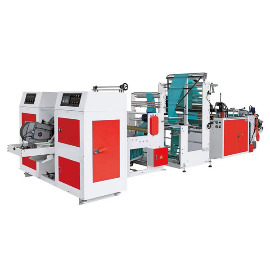
Plastic Bag Making Machine
Verification methods: After calibration or alignment, a test run is performed using a standard film. The bag dimensions, seal strength, and registration are measured. The data is compared to the machine's baseline. If any parameter is out of tolerance, further adjustments are made. The machine's control system can store calibration and alignment data, providing a history for trend analysis. For example, if the temperature offset has been increasing over several calibrations, it indicates thermocouple aging and the need for replacement.
Calibration tools and equipment: A certified temperature calibrator (e.g., a dry-well or an oil bath) is needed for thermocouple calibration. A dead-weight tester or a digital pressure calibrator for pressure transducers. Laser alignment tools and dial indicators with magnetic bases for mechanical alignment. The tools must be calibrated themselves, with traceability to national standards. The machine's maintenance manual provides detailed step-by-step procedures with diagrams. The maintenance team should be trained in these procedures; competency tests are recommended.
Documentation: All calibration and alignment activities are recorded in the machine's logbook or electronic system. The record includes the date, performed by, reference instrument used, readings, adjustments made, and the verification test results. This documentation is essential for quality audits and for tracking the machine's performance over time. By adhering to rigorous calibration and alignment procedures, bag making machines maintain high precision, producing consistent bag quality and minimizing rejects, while also extending the life of mechanical components by ensuring they operate within their design tolerances.