Bag Making Machine Maintenance Technical Deep Dive: Predictive Lubrication and Wear Monitoring
Preventive maintenance of bag making machines has evolved from time-based schedules to condition-based, predictive approaches. The core of predictive maintenance is monitoring the health of critical components – bearings, gears, linear guides, and actuators – using vibration analysis, oil analysis, and thermal imaging. For bearings in high-speed shafts (e.g., film pull rollers, rotary cutters), the vibration signature is analyzed using FFT (Fast Fourier Transform) to detect early-stage defects like raceway wear, ball deformation, and cage damage. The overall vibration level is measured in mm/s RMS; an increase of 0.5 mm/s over baseline indicates developing wear. The machine's control system includes an accelerometer on each critical bearing housing, with a sampling rate of 10 kHz. The vibration data is processed by an edge device that calculates the spectral energy at bearing characteristic frequencies (BPFO, BPFI, BSF, FTF). If the energy exceeds a threshold, an alert is generated. The system also tracks the bearing temperature; a rise of 10°C above normal indicates lubrication failure or misalignment. For gearboxes, oil analysis is performed: samples are taken and sent to a lab for particle count, viscosity, water content, and acid number. In-line sensors (dielectric constant, magnetic plug) provide real-time wear debris monitoring. The particle count (ISO 4406 code) is monitored; a code increase from 16/14 to 18/16 indicates accelerated wear. The lubrication intervals are determined by the oil's condition, not just hours; the machine's controller calculates the remaining oil life based on temperature and contamination.
Lubrication system design: Modern bag making machines use centralized lubrication systems with a pump that distributes grease or oil to multiple points at programmed intervals. The system is controlled by the PLC, with a pressure sensor to detect blockages. The lubricant type is specified for each application: high-temperature grease for sealing bar bearings, EP (extreme pressure) oil for gearboxes, and food-grade lubricants for bearings near the film path (NSF H1). The lubrication schedule is stored in the machine's recipe; it can be adjusted based on the machine's speed – higher speed requires more frequent lubrication. The system also includes a filtration unit for oil circulation to remove particles. The filter's differential pressure is monitored; a rise indicates filter clogging. The lubrication reservoir has a level sensor; low level triggers an alarm. The machine's control system logs lubrication events and can alert when the grease cartridge is near empty.
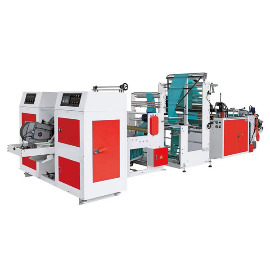
Plastic Bag Making Machine
Bearing life estimation: Using the vibration and temperature data, the machine calculates the remaining useful life (RUL) of each bearing using a physics-based model (e.g., Paris-Erdogan crack growth) or a machine learning model trained on historical failure data. The RUL is displayed on the HMI, with a color code: green (healthy), yellow (monitor), red (replace soon). The system suggests a replacement window (e.g., "replace within 200 operating hours"). This allows maintenance to be scheduled during planned downtime, avoiding unplanned stoppages. The RUL estimation is updated after each production run. The accuracy of the model improves with more data; the system provides a confidence interval. For critical bearings (e.g., the main drive), a redundant bearing set may be installed with a clutch to enable quick replacement.
Maintenance documentation: The machine's control system automatically generates maintenance reports, including lubrication logs, vibration trends, and RUL estimates. These reports are accessible via the HMI or exported to the plant's CMMS. The system also tracks the maintenance history of each component, enabling root cause analysis if a failure occurs. The operator can manually add notes (e.g., "bearing replaced on 2026-06-15"). By implementing predictive lubrication and wear monitoring, bag making machines achieve higher reliability, reduce maintenance costs, and extend component life, ensuring continuous production with minimal interruptions.