Bag Making Machine Output Technical Deep Dive: OEE Analysis and Bottleneck Identification
The effective output of a bag making machine is best measured by OEE (Overall Equipment Effectiveness), which accounts for availability, performance, and quality. OEE = Availability × Performance × Quality. Availability measures the machine's uptime: (Total Time - Downtime) / Total Time. Downtime includes planned maintenance, changeovers, breakdowns, and setup. Performance measures speed: (Actual BPM / Rated BPM) × 100%. Quality measures the percentage of good bags: (Total Bags - Rejects) / Total Bags. For a typical bag making machine, OEE of 80-85% is considered world-class. The OEE is calculated automatically by the machine's control system, which logs downtime reasons, speed, and reject count. The OEE data is displayed on the HMI and sent to the MES. The buyer should set an OEE target and monitor it regularly. If the OEE is below target, the loss categories are analyzed to identify the bottleneck. The six big losses are: 1) Breakdown losses – unplanned downtime. 2) Setup/Adjustment losses – changeover time. 3) Idling/Minor stoppages – short stops (e.g., splices, jam clearing). 4) Reduced speed – running below rated speed. 5) Quality defects – rejects. 6) Startup losses – rejects during startup. The machine's control system categorizes each downtime event (e.g., "film break," "seal jam," "changeover") and calculates the total loss for each category. A Pareto chart is used to identify the most significant loss. For example, if breakdown losses account for 40% of the total loss, the focus is on reducing breakdowns through predictive maintenance.
Bottleneck identification: The bottleneck is the stage or component that limits the machine's overall output. In a bag making machine, the bottleneck is often the sealing station (dwell time), the cooling station (cooling time), or the stacking station (speed). To identify the bottleneck, the operator can run the machine at maximum speed and observe which station causes the first quality issue or jam. The control system can also perform a "speed ramp" test: it gradually increases the speed until a defect occurs; the speed at which the defect occurs is the bottleneck limit. The bottleneck can be alleviated by: 1) Upgrading the bottleneck component (e.g., a faster servo motor for the sealing bar). 2) Adjusting the process parameters (e.g., using a higher temperature to reduce dwell). 3) Redesigning the component (e.g., a lighter sealing bar for faster motion). 4) Adding a buffer (e.g., an accumulator to decouple stations). The OEE analysis also helps in capacity planning: if the machine's OEE is 80%, its effective output is 80% of its rated output. When planning for new orders, the buyer should use the effective output, not the rated output.
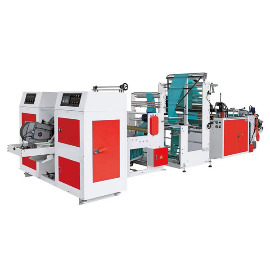
Plastic Bag Making Machine
Continuous improvement: The OEE data is used for continuous improvement. The machine's control system generates daily, weekly, and monthly OEE reports. The reports are reviewed in production meetings, and improvement actions are assigned. For example, if changeover time is a major loss, the team can work on standardizing changeover procedures and using quick-change tooling. If breakdowns are high, the team can implement predictive maintenance (vibration analysis, oil analysis). The OEE data is also used to benchmark different machines in the fleet. The machine with the highest OEE is analyzed to identify best practices that can be applied to other machines. The OEE improvement is tracked over time; a 5% OEE improvement can significantly increase output and profitability. By using OEE analysis and bottleneck identification, bag making machine operators can systematically improve the effective output, reduce costs, and meet production targets more reliably.