Bag Making Machine Output Technical Deep Dive: Speed vs. Quality Optimization and Thermal Limitations
The maximum output of a bag making machine is often limited by the thermal dynamics of the sealing process. To increase speed, the sealing dwell time must be reduced, which requires higher sealing temperatures. However, higher temperatures can cause film degradation, burn-through, or sticking. The relationship between speed and temperature is governed by the Arrhenius equation: the seal strength is a function of the time-temperature integral. For a given film, there is an optimal temperature range; exceeding it increases the risk of defects. For example, for 50-micron LDPE, the optimal sealing window is 120-160°C with a dwell of 0.2-0.5 seconds. If the machine speed is increased, the dwell time decreases; to maintain seal strength, the temperature must be increased. However, if the temperature exceeds 180°C, the film may degrade. The machine's control system uses a thermal model to calculate the required temperature for the current speed. The model is calibrated for each film type. The maximum speed is determined by the temperature limit and the cooling capacity. The cooling system (chill rollers) must be able to cool the seal sufficiently before the next cycle; if cooling is insufficient, the seal may weaken or the film may stick. The chill roller's surface temperature and the contact time are the limiting factors. The cooling time is proportional to the film thickness; thicker films require longer cooling, reducing speed. The machine's output is also limited by the film feed acceleration; high acceleration can cause film slip and registration errors. The acceleration profile is optimized to balance speed and tension stability. The machine's servo system's torque and response time are also factors.
Output optimization strategies: 1) Use high-quality film with good sealability (low melting point, wide sealing window). 2) Use a servo-driven sealing bar with fast response to minimize the dead time. 3) Use a rotary cutter to eliminate the cutting dwell time. 4) Optimize the acceleration profile to reduce film feed time. 5) Use a high-efficiency cooling system (water-cooled chill rollers with high heat transfer). 6) Use impulse sealing for thin films (to reduce heat buildup). 7) Reduce the bag length (shorter bags have shorter feed times). 8) Use a multi-lane machine to increase output without increasing speed. The machine's control system can automatically adjust the speed based on the seal quality (measured by an in-line seal tester). If the seal strength drops, the speed is reduced. This closed-loop control ensures that the output is maximized within the quality limits. The machine also has a thermal protection system that reduces speed if the sealing bar temperature exceeds the limit. The output is also affected by the film's thickness and width; wider and thicker films require more heat, reducing speed. The machine's maximum speed is specified for a reference film (e.g., 50-micron LDPE, 400 mm width). For other films, the speed is derated.
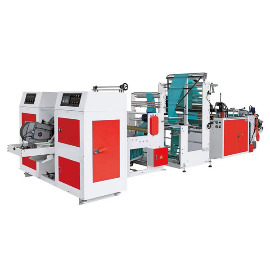
Plastic Bag Making Machine
Output measurement and reporting: The machine's HMI displays the current output in BPM (bags per minute) and the total production count. The output is also expressed as bags per hour and per shift. The machine's control system logs the output data for OEE calculation. The operator can set production targets; if the machine falls below the target, the system alerts the operator. The output is also measured in terms of material consumption (kg per hour). The buyer should consider the output when sizing the machine; the machine should have a 20% buffer above the required output to accommodate speed reductions due to film changes. The output is also affected by changeover time; frequent changeovers reduce the average output. Therefore, quick-change tooling is important for maintaining high output. By optimizing the speed-quality trade-off and using advanced control, bag making machines can achieve high output while maintaining consistent bag quality, maximizing productivity and profitability.