Bag Making Machine Production Process Technical Deep Dive: In-Line Quality Control and Reject Management
In-line quality control is an integral part of the
bag making machine production process, ensuring that only defect-free bags proceed to packaging. The quality control system typically includes a vision inspection system positioned after the sealing and cutting stations, but before stacking. The vision system uses high-resolution cameras (4-12 MP) with bright LED lighting and a background that provides contrast. The cameras capture images of each bag, and image processing algorithms analyze them for defects: seal defects (weak, burned, wrinkled), print defects (misregistration, smearing, missing colors), dimensional defects (length/width out of tolerance), and surface defects (gels, black specks, scratches). The algorithms use pattern matching, edge detection, and texture analysis. For high-speed lines (250 BPM), the camera's exposure time must be under 1 ms, and the processing time under 10 ms. The system often uses FPGA-based processing to achieve this speed. The vision system is calibrated for the bag's dimensions and print pattern; a reference image is stored for comparison. The system can be trained to detect specific defects using machine learning (deep learning) with a dataset of defective images. The detection accuracy is typically 99.5% with a false positive rate under 0.5%.
Defect classification and rejection: When a defect is detected, the bag is marked for rejection. The marking can be done by an ink jet that prints a dot on the bag, or by a signal sent to the rejection mechanism. The rejection mechanism is typically a pneumatic air blast or a mechanical diverter placed after the vision station. The air blast ejects the defective bag into a reject bin before it reaches the stacker. The rejection mechanism must be fast (under 20 ms) to avoid disrupting the flow. The reject count is logged, and the defect type is recorded. The data is used for statistical process control (SPC) – if the reject rate exceeds a threshold (e.g., 2%), the machine alerts the operator. The operator can then investigate the root cause (e.g., temperature drift, film quality) and adjust the machine. The vision system also provides feedback to the control system: if many bags have registration errors, the system can automatically adjust the registration phase. This closed-loop control reduces rejects in real-time.
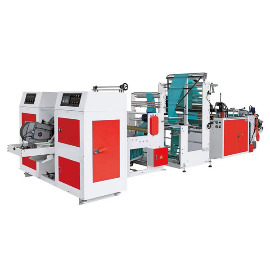
Plastic Bag Making Machine
Integration with MES: The quality data from the vision system is sent to the Manufacturing Execution System (MES) for batch traceability. The MES links the reject data to the film batch, machine settings, and operator. This enables root cause analysis and continuous improvement. For example, if a particular film batch has a high reject rate, the buyer can reject the batch from the supplier. The data is also used for quality certificates that accompany the shipment. The vision system can also be used for counting and verifying the bundle count. The machine's control system can be set to stop automatically if the reject rate exceeds a critical level, preventing a large number of defective bags from being produced. The vision system is calibrated daily using a reference bag (with known defects) to ensure its accuracy.
Types of vision systems: There are two main types: 2D area scan cameras for flat bags, and line scan cameras for continuous film (for winding machines). Area scan cameras capture a full image of each bag; line scan cameras capture a row of pixels as the film moves, reconstructing the image. Line scan cameras are more expensive but provide higher resolution for long bags. The lighting is critical – LED bars with diffusers are used to provide uniform illumination. The background is chosen to contrast with the bag (e.g., black background for white bags). The vision system also includes a synchronization signal from the machine's encoder to trigger the camera at the correct moment. The image processing algorithms are developed using tools like Halcon or OpenCV. The algorithms are optimized for speed; they use blob analysis, edge detection, and morphological operations. For print inspection, the algorithm aligns the print pattern with a reference and measures the deviation. The system can also detect color deviations using RGB or HSV color spaces. By implementing robust in-line quality control, bag making machines can achieve near-zero defective bags, ensuring high customer satisfaction and reducing waste.