Bag Making Machine Production Process Technical Deep Dive: Unwind, Sealing, Cutting, Stacking Cycle Timing
The bag making machine production process is a tightly synchronized sequence of operations: film unwinding, tension control, printing (optional), sealing, cooling, cutting, and stacking. The cycle time is determined by the slowest operation. For a typical bottom-seal flat bag machine running at 250 BPM, the total cycle time is 240 ms. The cycle starts with the film feed: the pull rollers accelerate the film, pull it forward by the bag length, and decelerate to a stop. This feed phase occupies about 100-120 ms. During the feed, the sealing bars are open, and the cutter is retracted. When the film stops, the sealing bar closes (10 ms), applies heat and pressure for the dwell (40-50 ms), and opens (10 ms). The cutter then operates (20-30 ms), either during the dwell (for rotary cutters) or after the seal (for guillotine). The stacking conveyor moves during the feed phase. The timing is controlled by a master encoder that generates a virtual time base; each axis (film pull, sealing bar, cutter, stacker) follows a cam profile relative to this time base. The cam profiles are designed to minimize acceleration and jerk, reducing mechanical stress. The timing is optimized to ensure that the sealing bar is fully open before the film feed starts, and that the cutter is clear before the next feed. The temperature control is also timed: the heater power is increased during the feed phase to compensate for heat loss during the sealing dwell.
Detailed timing diagram: For a 250 BPM cycle (240 ms): t=0 to t=50 ms: film feed (acceleration, constant speed, deceleration). t=50 to t=60 ms: film settles (dwell). t=60 to t=70 ms: sealing bar closes. t=70 to t=120 ms: sealing dwell (heat and pressure). t=120 to t=130 ms: sealing bar opens. t=130 to t=160 ms: cutter actuates (for guillotine). t=160 to t=240 ms: idle (film feed preparation, stacker movement). The actual timing may vary with bag length and film thickness. Longer bags require longer feed time, reducing the available dwell time. Thicker films require longer dwell, reducing the feed time. The machine's control system adjusts the timing automatically based on the bag length and film recipe. The timing can be optimized using a "speed vs. bag length" curve; the machine can automatically reduce speed if the dwell time is insufficient. The timing is also affected by the machine's mechanical condition; worn bearings or misaligned linkages can increase the time required for acceleration and deceleration, reducing the effective speed. Regular maintenance is needed to keep the timing precise.
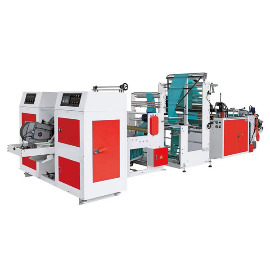
Plastic Bag Making Machine
Synchronization of axes: The film pull, sealing bar, and cutter axes are electronically synchronized. The film pull servo follows a position profile; the sealing bar servo follows a force profile with position limits; the cutter servo follows a phase profile. The synchronization is maintained by the motion controller, which uses a high-speed communication bus (EtherCAT) to send setpoints to each drive at 1 ms intervals. The position error of each axis is measured by an encoder and fed back to the controller. The controller adjusts the setpoints to minimize the following error (typically <0.05 mm). The synchronization is critical for registration accuracy; any drift between the film pull and the cutter causes bag length errors. The machine's control system also compensates for thermal expansion of the film by adjusting the film pull timing based on the film temperature. The synchronization is tested during the FAT and verified during the SAT.
Process optimization: The cycle time can be reduced by: 1) Increasing the sealing temperature to reduce the required dwell time, but this risks burn-through. 2) Using high-speed servos with faster acceleration, but this may cause film slip. 3) Using a rotary cutter to eliminate the cutter dwell time. 4) Overlapping operations – e.g., starting the film feed while the sealing bar is still opening (if the bar is clear of the film path). 5) Using a dual-lane machine to double the output. The machine's control system can be tuned to find the optimum trade-off between speed and quality. The buyer should work with the supplier to optimize the machine for their specific film and bag design. By understanding the production process cycle timing, operators can diagnose bottlenecks and improve throughput.