Bag Making Machine Raw Material Technical Deep Dive: Film Properties and Processability
The raw material for bag making machines is plastic film, supplied in roll form. The film's physical and thermal properties directly affect the machine's performance, including sealing temperature, tension control, and cutting quality. Key properties include: Melt Index (MI) – a measure of the polymer's flowability; a higher MI (e.g., 2-4 g/10min for LDPE) indicates easier melting and sealing, but may reduce tensile strength. Tensile Strength – the maximum force the film can withstand before breaking; typically 10-20 MPa for LDPE, 20-35 MPa for HDPE. Higher tensile strength allows higher tension settings without breakage. Tear Resistance – the force required to propagate a tear; important for bags that need to resist punctures. Elmendorf tear strength is typically 100-500 g for LDPE. Coefficient of Friction (COF) – the film's slipperiness; a COF of 0.2-0.4 is optimal for smooth feeding. Too low COF causes slipping; too high causes sticking. Optical Properties – clarity, haze, and gloss; important for retail bags. The film's thickness uniformity is critical; a variation of ±5% can cause sealing defects and bag length variation. The film's density (0.91-0.96 g/cm³ for PE) affects the yield (bags per kg of film). The film's additives (slip agents, anti-block agents, antistatic agents) are blended to improve processability. The slip agent migrates to the surface, reducing COF; the anti-block agent creates microscopic roughness to prevent blocking. The additive concentration must be controlled; too much slip agent can contaminate the sealing area, reducing seal strength.
The film's thermal properties determine the sealing parameters: Melting Point – the temperature at which the film starts to melt; for LDPE, 105-115°C; for HDPE, 125-135°C; for PP, 160-170°C. The sealing temperature is typically set 20-30°C above the melting point. Heat Seal Strength – the strength of the seal as a function of temperature; the optimal window is narrow (10-20°C). If the temperature is too low, the seal is weak; too high, the film burns. The film's heat resistance affects the cooling time; a film with high heat resistance requires longer cooling. The film's shrinkage – the tendency to shrink when heated; high shrinkage causes wrinkles and mis-registration. The shrinkage is measured by placing a film sample in an oven at 120°C for 5 minutes and measuring the dimensional change. For PE films, shrinkage is typically 2-5%. The film's moisture content (for biodegradable films) affects sealing; moisture acts as a plasticizer, lowering the melting point. The film should be stored in a dry environment (humidity < 50%) to maintain consistent properties. The film's gauge (thickness) is measured in microns; a typical range is 15-200 microns. Thicker films require higher sealing temperature and longer dwell. The film's width is specified; the machine's maximum width must accommodate the film. The film roll's core diameter and maximum roll weight are also specified for the unwind stand.
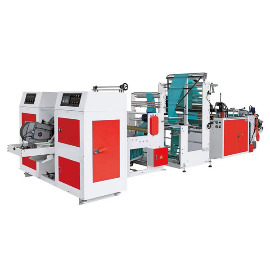
Plastic Bag Making Machine
Impact of film properties on machine settings: 1) High MI (flowable) film requires lower sealing temperature but longer dwell to avoid burn-through. 2) High tensile strength film allows higher tension, reducing wrinkling. 3) High tear resistance film requires sharper blades and higher cutting force. 4) High COF film needs lower tension and anti-stick coating on rollers. 5) High shrinkage film requires careful cooling to avoid wrinkles. The machine's control system stores recipes for each film type; the recipe includes sealing temperature, pressure, dwell, tension, and cooling settings. The operator enters the film type, and the machine automatically adjusts the settings. The film's properties are tested by the supplier; the buyer should request a material data sheet. The buyer should also perform incoming quality checks: thickness measurement, visual inspection for gels and scratches, and COF measurement. If the film does not meet the specifications, it should be rejected to prevent production issues.
Film handling and storage: The film rolls are stored horizontally on racks to prevent deformation. The storage area should be clean and dry, with a stable temperature. The film should be used on a first-in-first-out (FIFO) basis to prevent aging (additives can migrate over time). The film roll's edge must be protected to prevent damage. The roll is loaded onto the unwind stand using a roll hoist; the core must be centered on the shaft. The film's splice must be made with a thin, strong tape; the splice is marked for detection by the machine. The film's surface must be free of dust and static; a static eliminator is used. By understanding the raw material's properties and their impact on processability, bag making machine operators can optimize the machine settings, reduce waste, and produce consistent, high-quality bags.