Bag Making Machine Specification Deep Dive: Mechanical and Structural Specifications
The mechanical specifications of a bag making machine define its structural integrity, durability, and precision. Key mechanical parameters include frame construction (material, thickness, welding), shaft diameters and tolerances, bearing types and ratings, and guide system specifications. The machine frame is typically fabricated from heavy-gauge steel (10-20 mm thick) with reinforced ribs and gussets to achieve high stiffness – a critical factor in maintaining alignment at high speeds. The frame's natural frequency must be above the machine's operating frequency to avoid resonance; this is specified as a minimum stiffness (e.g., 10^7 N/m). The frame's flatness and parallelism tolerances are specified as ±0.05 mm per meter to ensure accurate mounting of components. The main drive shaft is often made of hardened alloy steel with a diameter of 50-100 mm, supported by heavy-duty spherical roller bearings with a dynamic load rating (C) of 50-100 kN to handle the cyclical loads. The bearing life (L10) is specified in operating hours, typically 20,000-50,000 hours, calculated from the bearing's dynamic load and the actual load. The shaft's runout tolerance is ±0.01 mm to minimize vibration. The connecting rods and linkages are designed with safety factors of 3-5 against fatigue failure, using finite element analysis (FEA) to verify stress distribution.
The sealing bar assembly is a critical mechanical subsystem. The bar's material (copper, aluminum, or steel) and its cross-section are specified to provide sufficient thermal conductivity and mechanical stiffness. The bar's deflection under the maximum sealing force must be less than 0.05 mm to ensure uniform pressure. This is calculated using beam deflection formulas and verified by FEA. The bar's surface flatness and coating thickness are specified (e.g., ±0.02 mm flatness, 0.1-0.3 mm PTFE coating). The actuators (pneumatic cylinders or hydraulic cylinders) are specified by bore size, stroke length, and maximum force. The seals are specified to withstand the operating pressure and temperature (e.g., nitrile or polyurethane). The guide system for the sealing bar uses linear ball bearings or wear strips with a specified dynamic load capacity and friction coefficient. The linear guides must have a running accuracy of ±0.02 mm. The cutter mechanism (guillotine or rotary) has specified blade material, hardness (HRC 58-62), and sharpening intervals. The cutter's anvil or counter-blade is specified with a hardness of HRC 55-60 and a wear allowance.
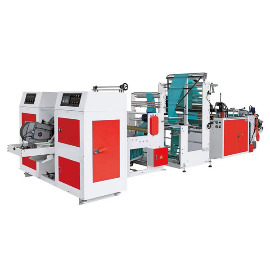
Plastic Bag Making Machine
The film handling system includes unwind stand, dancer roller assembly, and pull rollers. The unwind stand's shaft is specified with a maximum load capacity (e.g., 500-1000 kg) and a core diameter compatibility. The dancer roller has a specified mass and stroke (e.g., 5-10 kg, 200 mm stroke) to provide adequate tension buffering. The pull rollers are specified with a diameter (e.g., 100-200 mm), surface material (rubber or polyurethane), and hardness (60-80 Shore A) for optimal grip. The roller surface must be dynamically balanced to grade G2.5 to avoid vibration. The nip pressure is specified as a force per unit length (e.g., 10-50 N/cm) and is achieved by pneumatic cylinders. The edge guide's mechanical components (steering roller, actuator) have specified travel range and accuracy. The stacking system's conveyor and compression plate have specified speed and force capacities.
Wear parts specifications: The sealing bar coverings (Teflon tape) have specified thickness, width, and maximum temperature. The heating elements have specified wattage, voltage, and geometric dimensions. The thermocouples are specified by type (J, K, T), accuracy class, and response time. The blades are specified by dimensions, material, and cutting edge geometry. All these components have expected lifetimes specified in operating cycles or hours, which are used for preventive maintenance scheduling.
Environmental specifications: The machine's operating temperature range (e.g., 5-45°C), humidity range (20-80% non-condensing), and noise level (e.g., <80 dB(A) at maximum speed) are specified. The machine's IP rating for electrical enclosures is specified (e.g., IP54) to protect against dust and water splashes. The overall dimensions (length, width, height) and weight are specified for facility planning. The floor mounting requirements (anchor bolt sizes, loads) are also provided. By adhering to these mechanical specifications, bag making machines achieve high precision, long service life, and safe operation, ensuring that the machine can withstand the rigors of continuous production and maintain its performance over years of use.