Bag Making Machine Speed Deep Dive: Cycle Time Optimization through Motion Profiling
The speed of a bag making machine is fundamentally limited by the cycle time – the total time required for one complete bag production cycle, including film advance, sealing, cooling, cutting, and stacking. For a machine running at 250 BPM, the cycle time is 240 ms. To achieve this, each motion must be precisely timed and optimized. The film advance occupies the largest portion of the cycle – typically 40-60% of the total time. The sealing dwell occupies 10-20%, cutting 5-10%, and the remaining time is for acceleration and deceleration. The primary strategy to reduce cycle time is to minimize the film advance time by using higher acceleration and deceleration rates. However, excessive acceleration causes film stretch and jerks, leading to registration errors and mechanical stress. The motion profile for the film pull is typically a trapezoidal velocity profile with S-curve acceleration. The S-curve limits jerk – the rate of change of acceleration – to reduce mechanical shock. The jerk is typically limited to 10-50 m/s³. The achievable acceleration is limited by the servo motor's torque, the film's tensile strength, and the system inertia. For a 500 mm bag length, the film must be pulled 500 mm in, say, 100 ms. With a trapezoidal profile, the average speed is 5 m/s, and peak speed is about 7.5 m/s. The acceleration required is 150 m/s² (15 g) – which is high but achievable with modern servos. However, such acceleration would cause excessive tension spikes and film stretching. Therefore, the acceleration is reduced, and the pull time is extended, reducing the speed. The optimization is a trade-off between speed and film quality.
The sealing bar motion also contributes to cycle time. The bar must descend, contact the film, dwell, and retract. The descent and retract times are minimized by using high-speed actuation (pneumatic or servo). For servo-driven bars, the profile is also S-curved to avoid impact. The dwell time is set by the sealing requirements; reducing dwell requires higher temperature, which may cause burn-through. Therefore, the speed is often limited by the sealing dwell, especially for thick films. The cutting mechanism (rotary or guillotine) must be synchronized. For rotary cutters, the cut is continuous, so no extra time is needed beyond the film advance. For guillotine, the cut must occur during a stopped period; this adds to the cycle. To minimize this, some machines use a "flying" guillotine that cuts while the film is moving, but this requires precise synchronization and is more complex. The stacking and discharge operations are typically overlapped with the next cycle, so they do not add to the cycle time if the stacker can keep up.
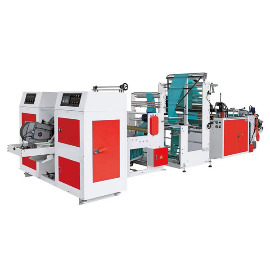
Plastic Bag Making Machine
Optimization methods: The machine's PLC can use an algorithm to calculate the optimal motion profiles based on the bag length, film type, and machine condition. For example, for a given bag length and film thickness, the algorithm determines the maximum allowable acceleration that does not cause film slip or stretch. This is done by modeling the film's behavior as a spring-mass system and setting limits on the tension variation. The algorithm also adjusts the sealing temperature based on the cycle time – shorter cycles require higher temperature to maintain seal strength. This feed-forward temperature compensation is crucial for maintaining quality at varying speeds. Additionally, the machine can employ a dynamic speed control – if the sealing temperature drops (due to high speed), the machine automatically reduces speed until the temperature recovers, then increases. This is known as thermal throttling.
Real-world speed limits: The maximum achievable speed is also limited by the film's cooling time. For thick films, the seal must be cooled sufficiently before stacking; otherwise, the bags stick together. This cooling time adds to the cycle if the chill roller is not efficient. Using water-cooled chill rollers with high heat transfer coefficients can reduce cooling time, allowing higher speed. Another limit is the registration system's response time – at high speeds, the registration error may increase due to sensor latency. Faster sensors and faster control loops can push the speed higher. The mechanical wear on moving parts increases with speed; hence, the machine's bearings and guides must be rated for the higher loads. The manufacturer specifies the maximum speed for each machine model, but the practical speed may be lower depending on film type and bag design. By optimizing motion profiles and using advanced control, bag making machines can achieve speeds exceeding 300 BPM for simple flat bags, while maintaining high quality, demonstrating the power of modern motion engineering.