Bag Making Machine Speed Deep Dive: Throughput Calculation and Production Efficiency
Machine speed is often quoted as the maximum theoretical BPM (bags per minute), but the actual production throughput is always lower due to various losses: setup/changeover time, film roll changeovers, maintenance stops, reject bags, and speed reductions for film quality. The effective throughput is calculated as: Effective BPM = Theoretical BPM × Availability × Performance × Quality, where Availability = (Planned Production Time - Downtime) / Planned Production Time, Performance = (Actual Run Speed / Theoretical Speed) × 100%, and Quality = (Good Bags / Total Bags) × 100%. For a well-run machine, OEE (Overall Equipment Effectiveness) is typically 80-90%, meaning a 250 BPM machine produces an average of 200-225 good bags per minute over a shift. The losses are categorized into six big losses: breakdown losses (unplanned downtime), setup/adjustment losses, idle/minor stoppages, reduced speed (due to film variations), quality defects (rejects), and startup/rework losses. To improve throughput, each loss must be quantified and addressed.
Speed loss due to film roll changeover: A typical roll change takes 2-5 minutes for manual rolls, and 1-2 minutes for automatic splicers. If the machine runs at 250 BPM and a roll lasts 2 hours, the changeover time is 2 minutes per roll, which is 1.7% loss. Automatic splicers reduce this to near-zero. Setup losses occur when changing bag size or film type; this can take 10-30 minutes. If changeovers happen twice per shift, the loss can be 5-10%. To reduce, use quick-change tooling and recipe recall. Reduced speed losses occur when the machine cannot run at rated speed due to film thickness (thicker film requires longer dwell, slowing speed) or film quality (wrinkles require slower speed). For example, running 100-micron film may reduce speed by 20% compared to 50-micron. The operator can adjust speed based on film quality; the machine may have an automatic speed reduction if the registration error exceeds a threshold.
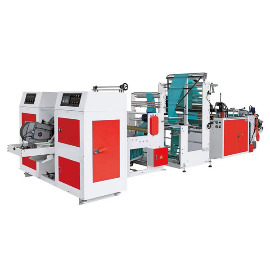
Plastic Bag Making Machine
Quality losses: Rejects occur due to seal defects, mis-cuts, mis-registration, or dirt. Typical reject rate is 1-3% for stable production. Rejects cost material and time; a 2% reject rate reduces throughput by 2%. To reduce rejects, ensure proper temperature and pressure, clean sensors, and use high-quality film. The machine's vision inspection system can automatically reject defective bags, preventing them from being counted in good output. The system can also log the reject reasons to identify root causes.
Capacity planning: To determine how many machines are needed to meet production demand, calculate the required effective throughput. For example, if the demand is 1 million bags per 8-hour shift, the required BPM = 1,000,000 / (480 min × 0.85 OEE) = 2,450 BPM? Wait, that's too high – correction: 1,000,000 / (480 min) = 2,083 BPM, but with OEE 0.85, the required machine rated speed = 2,083 / 0.85 = 2,450 BPM – unrealistic for a single machine; so multiple machines or longer shifts. Actually, a single high-speed machine may produce 250 BPM × 480 min × 0.85 = 102,000 bags per shift. So for 1 million bags, you need about 10 machines. This illustrates the importance of accurate throughput calculations for investment decisions.
Strategies to improve throughput: 1) Implement automatic splicers to reduce roll change downtime. 2) Use servo-driven quick-change tooling to reduce setup time. 3) Optimize sealing parameters to allow higher speed for thicker films (e.g., using higher temperature with precise control). 4) Use in-line inspection to catch defects early, reducing waste. 5) Train operators on efficient startup and changeover procedures. 6) Implement predictive maintenance to prevent breakdowns. 7) Use data analytics to identify the biggest loss category and focus improvement efforts. By continuously monitoring and improving OEE, bag making machine users can maximize the effective speed and production capacity, often achieving a 10-20% increase in output without buying additional machines, significantly improving return on investment.