Bag Making Machine Supplier Technical Deep Dive: Supplier Capability Audit and Scoring System
Selecting a bag making machine supplier requires a systematic capability audit that goes beyond price comparison. A comprehensive supplier audit evaluates the supplier's technical, manufacturing, quality, financial, and after-sales capabilities. The audit should be conducted on-site (or virtually with live video) by a cross-functional team including engineering, quality, and procurement. The audit covers: 1) Manufacturing facilities – assess the factory layout, machinery (CNC, grinding, welding), maintenance practices, and production capacity. 2) Quality management system – verify ISO 9001 certification, inspect quality control procedures, testing equipment (CMM, hardness testers, thermal imagers), and traceability of components. 3) Engineering and R&D – evaluate the number of design engineers, CAD/CAM capabilities, simulation tools (FEA, CFD), and track record of customizations. 4) Supply chain management – assess raw material sourcing, inventory management, and lead times for critical components. 5) After-sales support – evaluate service network, spare parts availability, response times, and warranty history. A scoring system is used: each category is weighted (e.g., manufacturing 30%, quality 25%, engineering 20%, supply chain 15%, after-sales 10%). Each sub-item is scored 1-5. A supplier with a score above 4.0 is considered "preferred." The audit report includes observations, non-conformities, and corrective action requests. The buyer should also request customer references and contact them to verify performance and support.
Technical due diligence: Beyond the general audit, a technical deep dive examines the supplier's design methodologies. For bag making machines, key technical areas include: motion control design (servo sizing, cam profiles), thermal management (heater placement, thermal FEA), structural analysis (frame stiffness, vibration damping), and material selection (for sealing bars, cutters). The supplier should provide design calculations and simulation reports. The buyer should review the machine's maintenance manual and spare parts list for completeness. The supplier's compliance with safety standards (CE, UL) and EMC requirements should be verified. The technical team should also assess the supplier's ability to provide training and documentation. A supplier that is transparent about its design and testing processes is more trustworthy. The audit should also include a review of the supplier's quality data (e.g., defect rates, first-pass yield) and continuous improvement programs (e.g., Six Sigma, Kaizen). By conducting a thorough capability audit and technical due diligence, buyers can identify suppliers that can consistently deliver high-quality, reliable bag making machines that meet their specific production needs.
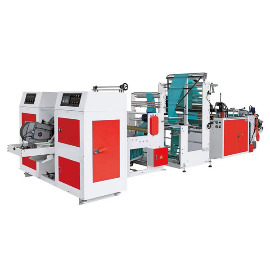
Plastic Bag Making Machine
Supplier scoring and risk assessment: After the audit, a risk assessment is performed. Risks are categorized as technical (e.g., immature design), quality (e.g., poor process control), financial (e.g., high debt), and supply chain (e.g., single-source components). The risk level (low, medium, high) determines the mitigation strategy. For high-risk suppliers, the buyer may require additional quality gates, such as third-party inspections and extended FAT. The scoring system helps in comparing multiple suppliers objectively. The buyer should also consider the supplier's innovation pipeline – are they developing new technologies (e.g., IoT, energy-saving)? A supplier that invests in R&D is likely to stay competitive and support the machine over its lifecycle. The audit findings are compiled into a supplier evaluation report, which serves as the basis for selection.
Post-audit engagement: After selecting a supplier, the buyer should establish a regular review cadence – quarterly performance reviews, annual supplier audits. The supplier's performance is tracked using KPIs: on-time delivery, quality reject rate, response time, and warranty claims. The buyer should share feedback and collaborate on continuous improvement. A supplier partnership approach, rather than a transactional one, yields better long-term results. For example, the buyer can involve the supplier in design-for-manufacturing (DFM) discussions to optimize the machine for production. By implementing a rigorous supplier audit and scoring system, bag making machine buyers can minimize risks, ensure quality, and build a reliable supply chain that supports their production goals.