Bag Making Machine Technical Parameters Deep Dive: Dimensional Accuracy and Tolerance Analysis
Dimensional accuracy is one of the most critical technical parameters in a bag making machine, directly affecting bag usability, sealing performance, and customer acceptance. The primary dimensional parameters are bag width, bag length, and seal position, each with specified tolerances. For high-quality bags, the width tolerance is typically ±1-2 mm, length tolerance ±1-3 mm, and seal position tolerance ±0.5-1 mm. These tolerances are influenced by the machine's mechanical precision, film feeding accuracy, and environmental factors. The dimensional accuracy is determined by the combined effect of several subsystems: the unwind stand's edge guide, the pull roller's positioning accuracy, the registration system's performance, and the cutting mechanism's repeatability. A tolerance stack-up analysis is performed during machine design to allocate tolerances to each component. For example, if the total length tolerance is ±2 mm, the pull roller encoder contributes ±0.5 mm, the registration sensor ±0.3 mm, and the cutting mechanism ±0.5 mm, with the remaining allowance for film stretch and thermal expansion. This allocation ensures that the final product meets specifications.
Bag length control is achieved through closed-loop feedback from the registration sensor. The sensor detects a print mark (or a pre-printed line) and measures the actual film feed per cycle. The error is used to adjust the pull servo's rotation. However, film stretch due to tension can cause the bag to be longer than the commanded length. This stretch is nonlinear and depends on film modulus, thickness, and tension. To compensate, the machine uses a stretch compensation algorithm: the commanded length is reduced by a factor that is a function of tension, calculated online from a load cell reading. For example, if the film has a 2% stretch at the current tension, the commanded length is set to 98% of the nominal length. The compensation factor is updated continuously. The registration system also compensates for thermal expansion of the film as it heats up in the printing or sealing sections. The machine's control system includes a temperature sensor on the film path and adjusts the length accordingly.
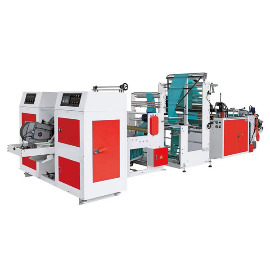
Plastic Bag Making Machine
Bag width accuracy is affected by the film's edge guide and the slitting process. The edge guide sensor (ultrasonic or optical) detects the film edge and positions it with a steering roller. The sensor's resolution is typically 0.1 mm, and the positioning accuracy is ±0.5 mm. However, film edge irregularities (from slitting) can cause wandering. To mitigate, some machines use a line guide that detects a printed line instead of the edge, providing more consistent reference. For bags produced from a tubular film (with side seals), the width is determined by the tube's lay-flat width, which is set by the extrusion and bubble diameter. The bag making machine does not control the absolute width but must maintain the seal position relative to the fold. The seal position tolerance is ensured by the edge guide or a separate fold sensor. The width variation is also affected by film tension, which can cause necking (reduction in width). At higher tension, the film narrows; the machine's tension control must be precise to keep width variation within tolerance.
Cutting accuracy is influenced by the blade sharpness, clearance, and synchronization. For rotary cutters, the gap between the blade and anvil is critical; a gap increase of 0.01 mm can cause a cut length variation of 0.2 mm due to film deflection. The blade wear is monitored by a sensor that measures the motor current; an increase in current indicates dulling. The machine automatically compensates by adjusting the cut timing. The cut length is also affected by the film feed roll's diameter and encoder resolution; a 0.1 mm diameter variation causes a 0.3 mm length error. Regular calibration of the feed roll diameter is performed by measuring the actual film advance over a known number of encoder pulses.
Temperature effects: The machine's frame and components expand with heat, changing the effective length of the film path. The thermal expansion coefficient of steel is 12e-6 /°C; a 10°C temperature change over a 2 m path causes a 0.24 mm expansion. This is significant for high precision. To compensate, the machine uses a thermal compensation model: it measures the ambient and component temperatures and adjusts the cut length and registration accordingly. The model is calibrated during commissioning. The control system also logs dimensional data (average length, width, and their standard deviations) per shift, using SPC to detect trends. If the standard deviation increases above a threshold, the machine alerts for maintenance. By understanding and controlling these dimensional parameters, bag making machines achieve the tight tolerances required for automated filling lines and high-quality packaging, ensuring customer satisfaction and reducing material waste.