Bag Making Machine Technical Parameters Deep Dive: Thermal, Pressure, and Power Specifications
The thermal parameters of a bag making machine are crucial for seal quality and energy consumption. The key thermal parameter is the sealing temperature, which must be maintained within ±1-2°C of the setpoint for consistent seal strength. The temperature is controlled by a PID loop with a feed-forward from the machine speed. The thermal system's response time – the time to reach a new setpoint or recover from a disturbance – is typically 10-30 seconds, depending on the heating element power and bar mass. The temperature uniformity across the bar is specified as ±2°C for standard applications and ±1°C for high-quality food packaging. This uniformity is achieved by zoning the heaters and using high-thermal-conductivity bar materials. The thermal power required is calculated from the heat needed to melt the film's seal area, plus heat losses to convection and radiation. For a typical machine running at 250 BPM, the thermal power is 3-8 kW. The specific heat and melting enthalpy of the film material determine the energy input per seal. For LDPE (specific heat 2.2 kJ/kg·°C, melting enthalpy 100 kJ/kg), sealing a 50-micron, 500 mm wide bag requires about 10-20 J per seal. At 250 BPM, the total heat input is 2.5-5 kW. The heaters must supply this plus compensate for losses. The controller's power output (duty cycle) is a metric; a high duty cycle indicates insufficient heater capacity or excessive heat loss.
Pressure parameters: The sealing pressure is specified in bar or kPa, typically 2-6 bar for pneumatic machines and up to 250 bar for hydraulic machines. The pressure determines the contact force between the sealing bars, which affects the intimacy of the melt contact. The pressure must be uniform across the bar length; a variation of >10% causes weak seals. The pressure is measured by a load cell or pressure transducer on the actuator. The force is calculated as Pressure × Area of the cylinder piston. For a 1200 mm bar, the required force is 2-5 kN for thin films and up to 50 kN for thick or multi-layer films. The pressure control accuracy is ±0.1 bar for pneumatic systems and ±2 bar for hydraulic systems. The pressure is regulated by a proportional valve or a pressure regulator. The pressure profile during the sealing cycle – rapid rise, dwell, and release – is specified to avoid film damage. The rise time should be <50 ms to prevent premature cooling. The dwell pressure must be held constant within ±5% to ensure consistent bonding. Some machines use a pressure ramp, where the pressure is gradually increased during the dwell to reduce air entrapment.
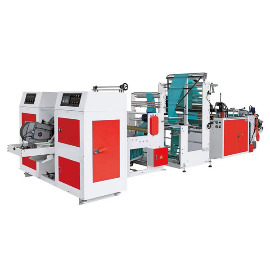
Plastic Bag Making Machine
Power consumption specifications: The total power consumption of a bag making machine includes electrical power for heaters, servo drives, control system, and auxiliary components (fans, pumps, conveyors). The typical power rating is 15-60 kW. The heaters account for 40-60% of total power. The servo drives consume about 20-30% during acceleration and much less during steady state. The control system and HMI use 1-2 kW. The auxiliary components (air compressor, chillers) are often external and not included in the machine's rating. The specific energy consumption (SEC) is measured in kWh per 1000 bags. For a modern servo machine, SEC is 10-20 kWh/1000 bags, while older clutch-brake machines may consume 25-40 kWh/1000 bags. The power factor is typically 0.8-0.95 for servo drives with active front ends. Harmonic distortion is minimized by line reactors or active filters. The power supply requirements are specified as voltage (e.g., 380-480V, 3-phase), frequency (50/60 Hz), and maximum current. The machine must be connected to a dedicated circuit with appropriate protection. The inrush current can be 5-10 times the rated current; soft-start devices are used to limit it. The machine's efficiency is also affected by the regenerative braking in servo drives; the regenerative energy can be fed back to the mains or dissipated in resistors. The specification includes the continuous power rating and the peak power rating for short-term overloads.
Cooling parameters: The cooling system's capacity is specified in kW. The heat load from the sealing bars and chill rollers must be removed to maintain stable temperatures. The cooling water flow rate and inlet temperature are specified (e.g., 10-20 L/min at 15-25°C). For air-cooled systems, the air flow rate and temperature rise are specified. The cooling system's control must maintain the chill roller temperature within ±2°C to ensure consistent seal solidification. The coolant pressure and quality (filtration, anti-corrosion) are also specified.
By precisely defining and controlling these thermal, pressure, and power parameters, bag making machines achieve optimal seal quality, energy efficiency, and reliability. The technical parameters are used for machine selection, installation design, and performance validation. Regular monitoring of these parameters (using built-in sensors and logging) allows operators to detect drifts and take corrective actions before quality issues arise, ensuring the machine operates within its design envelope for maximum productivity and longevity.