Bag Making Machine for Food Packaging Technical Deep Dive: Seal Integrity and Shelf Life Testing
For food packaging, the seal integrity directly affects the product's shelf life by preventing oxygen and moisture ingress. Bag making machines for food packaging must produce seals with consistent strength and hermetic properties. Seal strength is measured by peel test (ASTM F88), where a sample seal is pulled apart at a constant rate (e.g., 300 mm/min) and the force is recorded. The acceptable peel strength is typically 20-30 N/25mm for LDPE seals, and higher for PP seals. The failure mode should be film tearing, not seal delamination. The machine's control system can include an in-line peel tester that periodically takes a sample bag, cuts a test strip, and measures the peel force. If the force drops below a threshold, the machine adjusts temperature or pressure. The peel tester is often placed after the sealing station but before the stacker. It uses a pneumatic grip that pulls the seal and a load cell to measure force. The test is non-destructive to the bag's main seal, as it uses a separate seal test strip or an extra seal area.
Leak detection for food packaging is critical, especially for MAP (modified atmosphere packaging) where the gas composition must be maintained. Leak testing methods include pressure decay, vacuum decay, and CO2 detection. Pressure decay is the most common: the bag is placed in a chamber, and a vacuum is applied; the pressure change over time indicates leaks. For high-speed lines, a "sniffing" method can be used: a probe detects the presence of a tracer gas (e.g., helium or CO2) that has been introduced into the bag during filling. This is more sensitive but requires the gas flush system. The leak test sensitivity is set to detect holes as small as 10 microns. The machine's control system integrates the leak tester; if a leak is detected, the bag is rejected. The leak test data is logged for quality traceability.
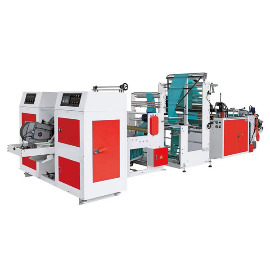
Plastic Bag Making Machine
Barrier performance: The bag's film must have low oxygen transmission rate (OTR) and water vapor transmission rate (WVTR) for long shelf life. The machine does not directly control these properties, but it must ensure that the sealing does not damage the barrier layers. For coated or laminated films, the sealing temperature must not exceed the barrier's degradation point. The machine's temperature control is critical to prevent delamination or pinholes in the barrier layer. The machine may have an in-line oxygen sensor that measures the oxygen concentration in the bag after sealing; if it exceeds a limit, the bag is rejected. This is particularly important for oxygen-sensitive products like coffee and meat.
Shelf life testing: The machine's seals are validated by accelerated shelf life testing, where filled bags are stored at elevated temperatures (e.g., 40°C) and humidity, and tested periodically for seal strength and integrity. The results are used to predict the product's shelf life. The machine's control system records the sealing parameters for each batch, allowing correlation with shelf life data. This helps in optimizing the sealing parameters for maximum shelf life.
Maintenance for seal integrity: The sealing bars must be kept clean and flat; any residue or wear causes weak seals. The thermocouples and heaters must be calibrated regularly. The pressure system must be inspected for leaks. The machine's control system monitors the seal strength trend and alerts if it drops, enabling proactive maintenance. By ensuring seal integrity and testing shelf life, bag making machines for food packaging deliver packaging that preserves food quality and safety, meeting consumer expectations for freshness and reducing food waste.