Bag Making Machine for Industrial Packaging Technical Deep Dive: Heavy-Duty Hydraulic Sealing Force Control
Industrial packaging machines produce heavy-duty bags and sacks with film thicknesses up to 300 microns and woven fabrics. The sealing force required can exceed 50 tons, far beyond pneumatic capabilities. Hydraulic systems are employed to deliver this force with precise control. The hydraulic cylinder's bore size is calculated from the required force and the system pressure (typically 200-250 bar). For a 50-ton force, the cylinder piston area must be about 200 cm² (diameter ~160 mm). The sealing bar stroke is usually 20-50 mm. The hydraulic power unit includes a variable-displacement pump (load-sensing) that adjusts flow based on demand, reducing energy consumption. Proportional directional and pressure control valves regulate the cylinder's speed and force. The pressure is controlled in a closed loop: a pressure transducer on the cylinder provides feedback to a PID controller that adjusts the valve's command signal. The pressure accuracy is typically ±2-5 bar. The pressure profile during the sealing cycle is crucial: a fast approach (low pressure, high flow), a rapid build-up to setpoint, a dwell at constant pressure, and a rapid release. The build-up time must be under 100 ms to maintain cycle speed. The valve's response time and the controller's tuning determine the profile quality. The system also includes a pressure relief valve for safety and an accumulator to supply peak flow and dampen pulsations.
Adaptive pressure control: The film thickness and material can vary, affecting the required force. The machine can use an adaptive algorithm that adjusts the pressure setpoint based on feedback from a seal quality sensor (e.g., a thickness gauge or a vision system). For example, if the seal appears weak (under-sealed), the pressure is increased for the next cycle. This adaptive control compensates for material variations and reduces rejects. The system also monitors the cylinder's position (using a linear encoder) to detect any sticking or slow movement, which could indicate seal wear or contamination. The control system logs pressure and position profiles, enabling predictive maintenance.
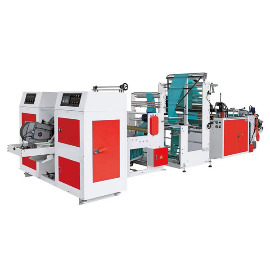
Plastic Bag Making Machine
Hydraulic system design for reliability: The hydraulic components (pump, valves, cylinders) are oversized for the maximum load to provide a safety margin. The oil is filtered continuously (ISO 16/13 cleanliness) to prevent valve sticking. The oil temperature is controlled by a cooler to maintain viscosity stability. The system includes a backup accumulator that can provide pressure for a few cycles in case of pump failure, allowing the machine to complete the current bag and stop safely. The cylinder seals are made of polyurethane or PTFE to withstand high pressure and temperature. The hydraulic hoses are reinforced with steel braid and protected from abrasion. The entire hydraulic unit is enclosed in a sound-dampening cabinet to reduce noise.
Force measurement and calibration: The actual sealing force is measured by a load cell or a pressure transducer. The load cell is mounted between the cylinder and the sealing bar, providing direct force measurement. The pressure transducer measures the cylinder pressure, and the force is calculated from the piston area. The control system uses the load cell for closed-loop control, which is more accurate than pressure-based control because it accounts for friction losses in the cylinder. The load cell is calibrated using a reference force gauge during commissioning. The calibration is verified periodically.
Maintenance: The hydraulic oil must be sampled and analyzed regularly for contamination and degradation. The filters are replaced based on differential pressure indicators. The cylinder seals and rod wipers are inspected for leaks. The proportional valves require periodic cleaning and calibration. The accumulator's pre-charge pressure is checked. By implementing robust hydraulic force control, industrial bag making machines achieve consistent, high-strength seals on thick, heavy-duty materials, essential for cement, chemical, and feed packaging.