Bag Making Machine for Industrial Packaging Technical Deep Dive: Valve Sack Formation and Block Bottom Sealing
Industrial packaging often uses valve sacks, which have a small opening (valve) that allows automatic filling, after which the valve self-closes. The valve is typically a paper or plastic tube, inserted into the bag's bottom or top corner. The valve insertion module is a complex subsystem: it feeds a continuous tube of valve material, cuts it to length (50-150 mm), folds it into a U-shape, and places it between the bag's layers at the sealing station. The valve material is often pre-coated with adhesive or is sealed in place by the main heat seal. The insertion position must be precise (±2 mm) to ensure that the filling spout aligns with the valve. The module uses servo-driven rollers, a rotary cutter, and a vacuum gripper for placement. The valve is often oriented at a 45-degree angle for automatic filling lines. The machine's control system coordinates the valve insertion with the film advance; the valve is placed just before the bottom seal is made. The adhesive application (hot melt) is synchronized to apply glue on the valve flanges before insertion. The adhesive amount is controlled by a positive displacement pump; too much causes oozing, too little causes weak bonding.
Block bottom sealing: The bottom of the sack is formed by folding multiple flaps (typically 4) into a flat, square shape. The folding station uses a series of tucking blades and folding plates that crease and fold the bottom. The crease lines must be precisely positioned; a deviation of 1 mm causes the bottom to be asymmetrical. The folding is done while the film is stationary. After folding, the flaps are pressed and sealed (or glued) by a bottom sealing station. The sealing station applies heat (if the film is heat-sealable) or adhesive. The pressure is applied by a hydraulic or pneumatic press, with a force of 5-15 tons to ensure complete bonding of all layers. The dwell time is longer (0.5-1.5 seconds) to allow heat or adhesive to set. The sealing press often has a contoured platen that matches the bottom shape. The bottom seal must be leak-proof and strong enough to withstand the product's weight (up to 50 kg). The machine's vision system inspects the bottom for flatness, symmetry, and seal quality.
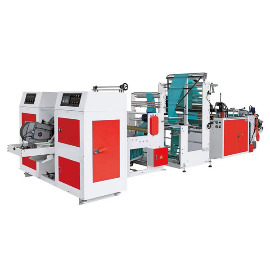
Plastic Bag Making Machine
Integration of valve and bottom forming: The valve insertion and bottom forming are done in sequence. First, the valve is placed, then the bottom flaps are folded and sealed over the valve, securing it in place. The valve must be positioned so that it is not obstructed by the flaps. The machine's timing is critical; any mis-synchronization causes the valve to be misaligned or the bottom to be weak. The machine's control system uses a master encoder to synchronize the valve inserter, folder, and sealer. The phase offsets are adjustable via the HMI. The machine also includes a test station that applies a small air pressure to the valve opening to verify its patency; a blocked valve triggers a reject.
Quality control: The valve position is checked by vision; if it deviates, the inserter is adjusted. The bottom seal strength is tested by a burst test on a sample sack. The adhesive coverage is checked by UV light. The machine logs all parameters for traceability.
Maintenance: The valve inserter's cutter and gripper require regular cleaning. The bottom folding plates must be kept clean and free of scratches. The hot melt applicator needs daily purging. The press platen's heating elements require calibration. By mastering valve sack formation and block bottom sealing, industrial bag making machines produce robust sacks that are compatible with high-speed automatic filling lines, reducing labor and improving packaging efficiency in heavy industries.