Bag Making Machine for Retail Technical Deep Dive: High-Speed Printing and Branding Integration
Retail bags are a critical branding tool; they carry store logos, promotions, and QR codes. Bag making machines for retail often integrate high-speed flexographic printing units with 2-8 colors to produce vibrant, eye-catching bags. The printing speed must match the bag making speed, typically 150-250 BPM. This requires a printing unit with fast-drying inks and precise registration. The flexographic stations are arranged vertically or horizontally, with each color having its own anilox roller, plate cylinder, and impression cylinder. The ink is transferred from the anilox roller to the plate, then to the film. The anilox roller's cell volume determines the ink laydown; for high-speed printing, a lower cell volume (2-3 BCM) is used to reduce ink consumption and drying time. The plate cylinder is servo-driven, allowing phase adjustment for registration. The registration system uses a high-speed camera (200+ frames per second) that detects registration marks and sends corrections to each color's servo. The correction is applied as a phase shift within the same cycle, enabling registration accuracy of ±0.2 mm at 250 BPM. The camera must be shielded from ambient light and vibration.
Drying system for retail printing: Water-based inks are common for retail bags due to low VOCs. They require a drying system with hot air (60-100°C) and IR assist. The dryer must be long enough to evaporate the water without overheating the film – typically 2-4 meters. For heat-sensitive films (e.g., biodegradable), UV curing is preferred, but UV inks are more expensive. The dryer's temperature is controlled by a PID loop, and the air flow is balanced to avoid film fluttering. The machine's control system adjusts the drying temperature based on the film speed; higher speed requires higher temperature or more IR power. The drying system's energy consumption can be significant; heat recovery systems can reduce energy costs by 20-30%. The printed film is cooled by a chill roller before entering the bag forming section to prevent smearing.
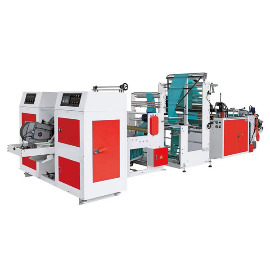
Plastic Bag Making Machine
Color management and consistency: The print quality is monitored by a color densitometer or a spectrophotometer that measures the color density and L*a*b* values. If the color deviates, the machine adjusts the anilox roller speed or ink viscosity. The ink viscosity is controlled by a viscometer that adds solvent or water automatically. The print unit also includes a doctor blade that scrapes excess ink from the anilox roller; the blade pressure must be constant to maintain consistent ink transfer. The blade is replaced regularly. The plate cylinder is cleaned after each production run to prevent ink drying in the plate cells.
Registration and repeatability: For multi-color prints, the registration marks are printed by the first color; subsequent colors detect these marks and adjust their phase. The machine's control system uses a digital image processing algorithm that can handle varying mark shapes and sizes. The registration error is logged, and if it exceeds the tolerance, the machine slows down or stops to prevent waste. The machine can also handle variable data printing (e.g., serialized barcodes) using an inkjet print head integrated after the flexo unit; this adds flexibility for promotional runs.
Maintenance of the printing unit: The anilox rollers require regular cleaning with a specialized cleaning system to prevent cell clogging. The doctor blades need replacement every 1-2 weeks. The plate cylinders must be wiped clean and protected from UV light. The registration camera needs calibration and lens cleaning. By integrating high-speed printing with precise control, bag making machines for retail produce attractive, branded bags that enhance brand visibility and customer loyalty, making them indispensable for retailers.