Bag Making Machine for Shopping Bags Technical Deep Dive: High-Speed Handle Punching and Die Optimization
Shopping bag machines, producing T-shirt and vest bags, rely on high-speed punching or die-cutting to create handle openings and notches. The punching mechanism operates at cycle rates up to 250 BPM, requiring exceptional durability and precision. The punch die is typically made of tool steel (D2, O1) or tungsten carbide, hardened to HRC 58-62. The cutting edge geometry – a bevel angle of 20-30 degrees – must be maintained to reduce cutting force and ensure clean edges. The cutting force is calculated from the film's shear strength (10-20 MPa for LDPE), the total cutting perimeter (typically 200-500 mm), and film thickness (15-60 microns). For a typical T-shirt bag, the force ranges from 200-800 N. The punch is driven by a servo motor or pneumatic cylinder with a profile that includes rapid descent, a brief dwell (5-20 ms) for cutting, and rapid retraction. The dwell time must be minimized to maintain cycle speed, but sufficient to allow the film to shear cleanly. The die plate (or anvil) is made of hardened steel or a polymer composite, with a clearance of 0.02-0.05 mm from the punch. The punch alignment is critical; misalignment causes uneven cutting and accelerated wear. Some machines use a floating punch head that self-aligns, reducing side loads. The punching station is integrated with the film advance; the film is stopped during punching in intermittent machines, or the punch can be synchronized with film motion using a "flying" punch mechanism that matches the film speed during the cut, allowing continuous motion and higher speeds.
Wear mechanisms in punching: The primary wear is abrasive wear from the film's fillers (e.g., chalk, titanium dioxide) and adhesive wear from the film's polymer residue. The punch edge dulls, increasing the required cutting force and causing ragged cuts. The punch life is typically 1-5 million cycles; it can be resharpened up to 5-10 times before replacement. The die plate also wears, and its slot widens, reducing cutting quality. To extend life, tungsten carbide punches offer 3-5 times longer life than steel. Some machines use a heated punch (50-80°C) to reduce the film's shear strength, lowering the cutting force and reducing wear, but requires careful temperature control to avoid melting. The punch station includes a scrap removal system – a vacuum or compressed air blow-off that removes the cut-out film pieces (handles and notches) to prevent them from contaminating the film path or jamming the mechanism.
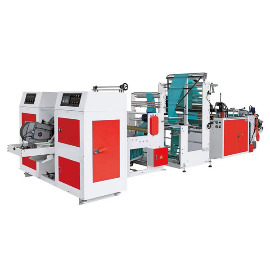
Plastic Bag Making Machine
Optimization of punch geometry: The handle shape (oval, D-shape, or keyhole) affects the stress distribution in the bag handle. A wider handle with rounded corners reduces stress concentrations, improving tear resistance. The punch design can include a slight taper to facilitate scrap ejection. For center notches, a V-shape with a 30-60 degree angle provides optimal tear initiation. The notch depth is typically 2-5 mm. The punch and die are often manufactured as a matched set, with the die being laser-cut or wire-EDM machined to ensure precise clearance. The machine's control system can adjust the punch depth and timing based on feedback from a vision system that inspects the handle cuts. If a defect is detected (e.g., incomplete cut, burr), the machine can automatically adjust the punch pressure or activate a cleaning cycle for the die.
Maintenance and monitoring: The punch and die must be inspected daily for residue buildup and wear. The punch edge can be checked using a microscope; when the edge radius exceeds 0.02 mm, sharpening is needed. The scrap removal system's suction pressure is monitored; a drop indicates a clogged filter or hose. The machine logs the punch cycle count and alerts when sharpening is due. The punch actuator's air pressure or servo torque is monitored; an increase indicates dulling. By optimizing punch design and maintenance, shopping bag machines produce clean, strong handles that meet retail durability standards, reducing customer complaints and bag failures during use.