Bag Making Machine for Shopping Bags Technical Deep Dive: Stacking and Bundle Compression for High-Speed Lines
Shopping bag machines produce bags at rates up to 250 BPM, and the stacking system must handle this throughput while creating neat, compressed bundles for retail packaging. The stacking system consists of a conveyor that brings bags from the cutting station, a reciprocating platform that builds the stack, a compression plate, and a discharge mechanism. The conveyor speed is synchronized with the bag output; bags are overlapped slightly to reduce spacing. A counting sensor (photoelectric or ultrasonic) detects each bag; the count is verified by a second sensor to eliminate false counts due to film flutter. The stack is built on a platform that descends as the stack height grows, maintaining a constant drop height (typically 50-100 mm) to prevent bag misalignment. An air blower or ionizing bar separates the bags to prevent sticking. The stack is built to a preset count (e.g., 50, 100, or 200 bags). During stacking, a compression plate applies intermittent pressure to flatten the stack. The compression force is typically 1-5 kPa, applied for 0.5-1 second per cycle. The force must be sufficient to reduce the stack height but not so high as to leave marks or compact the bags excessively. Some machines use a pre-compression stage before the main stack to improve bundle consistency.
Bundle discharge: When the count is reached, the stack is pushed off the platform by a pusher (pneumatic or servo-driven) onto a conveyor or packing table. The discharge pusher speed must match the bundle weight to avoid scattering. The bundle is then conveyed to a wrapping or boxing station. The machine's control system manages the stacking and discharge timing; it ensures that the discharge does not interrupt the stacking of the next bundle. The stacker can operate with "dual stack" – two platforms that alternate, allowing continuous stacking without pausing for discharge. This is essential for high-speed lines.
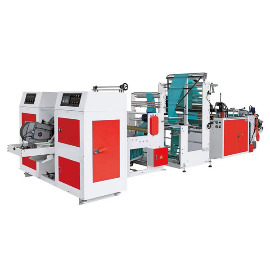
Plastic Bag Making Machine
Compression force optimization: The optimal compression force depends on the film thickness and bag size. Thicker films (50+ microns) require higher force (up to 8 kPa) to flatten, while thin films (15-20 microns) need lower force to prevent sticking. The force is controlled by a pneumatic regulator or a servo-driven press. The machine's control system can adjust the force based on the film recipe. The compression plate is often heated slightly (30-40°C) to reduce static and improve stack stability. The compression time is also adjustable; a longer compression reduces the stack height but reduces throughput. The stack height is measured by a sensor; if it exceeds a limit (indicating poor compression), the machine can increase the force or slow down.
Quality control of bundles: The bundle count is verified by a weight check – the bundle weight is compared to the expected weight (bags × average bag weight). If the weight deviates by more than 2%, the bundle is rejected. The bundle's squareness and edge alignment are inspected by a vision system. Misaligned bundles are diverted. The bundle is also checked for any loose bags or protruding handles. The machine logs bundle counts and rejects, providing data for SPC.
Maintenance: The stacking conveyor belts require regular cleaning and tension adjustment. The compression plate's surface must be smooth; any scratches cause bag marking. The counting sensors need cleaning and calibration. The discharge pusher's guide rails require lubrication. The air blower filters must be replaced periodically. By optimizing stacking and bundle compression, shopping bag machines produce retail-ready bundles that are easy to handle, reduce shipping volume, and minimize labor in downstream packaging, enhancing overall efficiency.