Bag Making Machine vs Form-Fill-Seal: Technical and Economic Comparison
Bag making machines (BMM) and form-fill-seal (FFS) systems are both used for flexible packaging, but they serve fundamentally different roles. A BMM produces empty bags that are later filled and sealed in a separate operation, while an FFS system integrates bag forming, filling, and sealing into one continuous process. This distinction has profound implications for production flexibility, speed, quality control, and capital investment. From a technical perspective, a BMM operates at higher speeds – up to 300 BPM for simple flat bags – because it only performs forming and sealing, without the complexities of product handling and weighing. In contrast, an FFS system is limited by the filling and weighing operations; typical speeds are 60-120 packs/min for granular products, and 20-60 for liquids or irregular items. The BMM's output is bags, which can be stored, shipped, or used by multiple filling lines, providing decoupling between bag production and filling. FFS, on the other hand, is a dedicated line; any downtime in the filler stops the entire operation.
Economic comparison: The capital cost of a BMM is significantly lower – a high-speed servo machine costs $80,000-$150,000, while a comparable VFFS with a multi-head weigher costs $150,000-$300,000. However, a BMM requires a separate filling machine, so the total line cost may be similar for low-volume production. For high-volume, dedicated product lines, FFS may be more cost-effective because it eliminates bag handling, reduces labor, and minimizes floor space. The operating cost: BMM requires additional labor for bag handling, but it offers flexibility to produce bags for multiple products. FFS reduces labor but requires frequent changeovers if multiple products are run. The total cost of ownership over 5 years: for a single product with high volume (e.g., 10 million bags/year), FFS may have a lower TCO due to labor savings. For a converter serving many customers with different bag styles, BMM is more suitable.
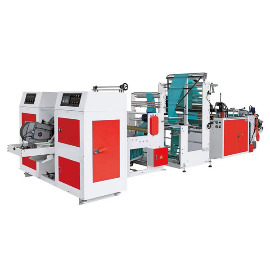
Plastic Bag Making Machine
Quality control: BMM produces bags with consistent seals because the sealing is optimized without the constraints of filling. FFS must balance sealing speed with filling; the seal may be compromised if the filling operation is slower. BMM allows for in-line inspection of empty bags (leak test, vision) without product contamination. FFS inspection is more complex because it must handle filled bags. Registration accuracy: BMM has a dedicated registration system that can be finely tuned; FFS registration is subject to variations from product flow.
Application suitability: BMM is ideal for retail bags, garbage bags, and industrial sacks where the bag is sold separately from the product. FFS is ideal for food packaging (snacks, frozen foods, liquids) where the bag is filled and sealed in a sanitary environment. For customized bags with complex closures (zippers, spouts), BMM is more flexible; FFS can handle some zippers but with lower speed.
Hybrid systems: Some machines combine BMM and FFS features – e.g., a BMM with an integrated filling station for low-volume products. These are niche solutions. The choice between BMM and FFS depends on the product type, volume, and supply chain strategy. For contract packagers, BMM offers the flexibility to produce a wide range of bag styles for different customers, while FFS is better for in-house production of a single product line. By understanding these technical and economic differences, manufacturers can make informed decisions that optimize their packaging operations.