Bag Making Machine with Printing Technical Deep Dive: Flexographic Print Unit Design and Registration Control
Integrating a flexographic printing unit into a bag making machine allows for inline printing of graphics, text, and barcodes directly onto the film before bag formation. The print unit consists of several stations, each for one color, arranged in a vertical or horizontal stack. Each station comprises an ink pan, a fountain roller, an anilox roller, a doctor blade, a plate cylinder with photopolymer printing plates, and an impression cylinder. The film passes between the plate cylinder and the impression cylinder; the plate cylinder transfers ink from the anilox roller to the film. The anilox roller has a ceramic surface with laser-engraved cells that carry a precise volume of ink; its cell volume (BCM, billion cubic microns per square inch) determines the ink laydown, typically 2-4 BCM for line printing and 1-2 BCM for process printing. The doctor blade scrapes excess ink off the anilox roller, leaving only the ink in the cells. The impression cylinder provides backup pressure (typically 1-3 bar) to ensure contact between the plate and film. The plate cylinder's circumference must match the repeat length of the print (which may be longer than the bag length for continuous patterns). The print unit is servo-driven, with its speed synchronized with the main film pull. Registration marks printed by the first color station are detected by a vision camera, and the subsequent color stations adjust their angular phase to align with those marks, achieving color-to-color registration within ±0.1 mm.
The printing plates are made of photopolymer, with a durometer (hardness) of 30-50 Shore A. The plate thickness is typically 1.14 mm or 1.70 mm, and it is mounted on the cylinder with double-sided tape. The plate's relief depth (the non-printing areas) must be deep enough to prevent contact with the film. The plate wear is a concern at high speeds; the lifetime is about 1-5 million impressions depending on the film abrasiveness. The ink system: water-based or solvent-based inks are used; water-based is preferred for food packaging due to low VOCs. The ink viscosity is measured by a viscometer and maintained by automatic solvent/water addition. The ink is circulated by a pump to ensure homogeneity. The drying system, typically hot air with IR assistance, evaporates the solvents or water. The drying temperature must be controlled to avoid film distortion; for heat-sensitive films, UV-curable inks with UV lamps are used, which cure instantly without heat.
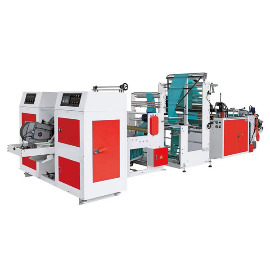
Plastic Bag Making Machine
Registration control: The camera (or photoelectric sensor) detects a registration mark printed on the film. The mark's position is compared to a reference. The error signal is sent to a servo drive that adjusts the phase of the plate cylinder for the corresponding color. The adjustment is made by shifting the cylinder's angular position relative to the film, using a differential gear or a direct servo. The response time must be under 20 ms to correct errors at 250 BPM. The control algorithm uses a PID with feed-forward from the film speed. For color-to-color registration, the first color is the master; subsequent colors follow its marks. The system must also compensate for film stretch between color stations, which can be up to 1-2 mm due to tension. This is done by measuring the distance between marks on adjacent colors and applying a correction to the plate cylinder's speed (a phase shift per cycle).
Print quality parameters: Dot gain (increase in dot size) is a common issue; it is controlled by the anilox cell volume and the printing pressure. A higher pressure causes more dot gain but better ink transfer. The print resolution is determined by the plate's line screen (80-150 lpi). The ink density is measured by a densitometer; consistency is achieved by controlling ink viscosity and anilox speed. The registration accuracy affects the overall print quality, especially for fine details and trapping. The camera system can also inspect for print defects like hickeys (ink clumps), streaks (scratched plate), and missing dots. The inspection data is logged and can be used to reject defective bags.
Maintenance: The anilox rollers must be cleaned regularly with a specialized cleaning system to prevent cell clogging. The doctor blade must be replaced every 1-2 weeks. The plate cylinders need to be wiped clean and protected from UV light. The printing unit's bearings and drives require regular lubrication. By integrating flexographic printing with precise registration control, bag making machines can produce high-quality printed bags at competitive speeds, adding branding and information directly in the production line, reducing handling and improving efficiency.