Bag Making Machine with Printing Technical Deep Dive: UV Curing and Drying Systems for Inline Printing
In bag making machines with inline printing, the drying/curing of inks is a critical process that affects print quality, film integrity, and production speed. For solvent- and water-based inks, hot air drying is common, but it requires sufficient dryer length and controlled temperature to avoid film distortion. For high-speed lines and heat-sensitive films (e.g., biodegradable PLA), UV curing is often preferred because it uses ultraviolet light to polymerize the ink instantly, without significant heat. UV curing systems consist of UV lamps (mercury or LED) that emit light in the UVA (320-390 nm) or UVV (390-420 nm) range, along with a reflector to focus the light onto the film, and a cooling system to remove heat. UV inks are 100% solids, so no solvents to evaporate, and curing is complete within milliseconds. The lamp's power is typically 10-30 kW per meter of width, and the curing speed is proportional to the lamp's intensity. For a 1200 mm wide machine running at 200 m/min, a UV system of about 20-30 kW is needed. LED-UV technology is becoming popular because it offers instant on/off, longer lamp life (20,000+ hours vs. 1,000 hours for mercury), and lower heat emission. However, LED UV requires specially formulated inks and has a higher initial cost.
Heat management in UV systems is essential because even though the film does not get hot from the UV light itself, the lamp generates infrared heat that can warm the film. The reflector is designed to filter out IR using dichroic coatings. Additionally, the lamp housing is water-cooled or air-cooled to extract heat. The film passes over a chill roller immediately after the UV unit to remove any residual heat. The cooling system must maintain the film temperature below its softening point (e.g., below 60°C for PLA). For heat-sensitive films, a cooling roller with water circulation at 10-15°C is used. The UV system's control monitors the lamp's power output and temperature; the lamp's intensity is adjusted based on the line speed – at higher speeds, more power is needed to deliver the same UV dose. The dose (mJ/cm²) is calculated as (lamp power × exposure time) / area; typically, 200-400 mJ/cm² is required for full curing. The system also includes a shutter to protect the film during stops.
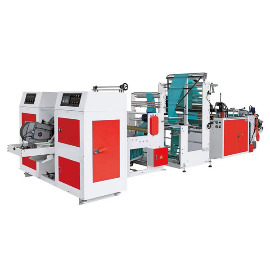
Plastic Bag Making Machine
Drying for water-based inks: Hot air drying uses a series of nozzles that blow heated air (60-100°C) onto the film, evaporating the water. The dryer length must be sufficient for the ink's water content and the line speed – typically 2-5 meters for a 200 m/min line. The air flow rate and temperature are controlled to avoid overheating. The air is recycled through a heat exchanger to save energy. The system includes an exhaust to remove moisture and solvent vapors. Water-based inks are more environmentally friendly but require more energy for drying than UV inks.
Integration with the bag making line: The curing/drying unit must be positioned between the last print station and the sealing section. The film tension through the dryer must be carefully controlled because the film may expand slightly with heat. A dancer or load cell is placed after the dryer to adjust tension. The dryer's length can affect the machine's footprint; some designs use a vertical dryer to save floor space. The control system coordinates the lamp power or dryer temperature with the line speed to ensure consistent ink curing. If the line accelerates, the UV lamp power must increase proportionally; this is done by a feed-forward signal from the speed controller.
Energy efficiency: UV curing is more energy-efficient than hot air drying because it uses electricity directly for the chemical reaction, not for heating air. However, the lamps themselves generate heat, which is often wasted. Some systems recover the heat from the lamp cooling water for other plant uses. LED-UV consumes about 50% less electricity than mercury lamps and has no warm-up time, reducing idle energy. The total energy consumption for a UV system is about 10-20% of the total machine energy. By choosing the appropriate curing technology and optimizing control, bag making machines with printing can achieve high-quality, durable prints on various films while maintaining high speed and energy efficiency. The choice between UV and hot air depends on the film type, ink chemistry, and environmental regulations, with UV gaining preference due to its environmental and productivity benefits.