Bag Making Machinery Technical Deep Dive: Control System Architecture and Real-Time Processing
The control system is the brain of bag making machinery, orchestrating all machine functions – film feed, sealing, cutting, stacking, and safety – with precise timing and coordination. Modern bag making machines employ advanced programmable logic controllers (PLCs) with multi-core processors, running real-time operating systems (RTOS) to handle deterministic task scheduling. The control system is divided into hierarchical levels: the main PLC handles sequence logic, safety, and communication; motion controllers (often integrated or dedicated) manage servo axes; and the HMI provides operator interface. The communication backbone is typically high-speed industrial Ethernet (EtherCAT, Profinet, or EtherNet/IP) with cycle times as low as 1 ms, ensuring tight synchronization between axes. The PLC program is structured in a cyclic scan, with each scan comprising input reading, logic execution, and output updating. For high-speed bag making at 250 cycles/minute (4.16 ms per cycle), the total scan time must be below 2 ms to leave margin for communication. Therefore, efficient programming using structured text (ST) or ladder logic with optimized algorithms is essential. Critical tasks like temperature PID control and registration correction are executed in dedicated interrupt routines with higher priority.
Motion control algorithms for bag making machinery have evolved from simple trapezoidal velocity profiles to sophisticated S-curve and jerk-limited profiles. The objective is to minimize mechanical stress while achieving the shortest possible cycle time. Each servo axis – film pull, sealing bar, cutting blade, punch – follows an electronic cam profile that is calculated offline based on the machine's mechanical constraints and then stored as a look-up table or generated on-the-fly by the motion controller. The film pull axis uses a position-based speed control with feed-forward compensation for roll diameter changes, maintaining constant linear speed. The sealing bar axis must synchronize with the film pull so that the bar contacts the film when the film is stationary (for intermittent sealing) or matches the film speed (for continuous sealing). In intermittent machines, the film is advanced, stopped, sealed, cut, and then advanced again – this stop-start motion requires precise acceleration/deceleration ramps to avoid film stretching. The motion controller uses a virtual master axis that generates a time base, and all slave axes are electronically geared to this master. Registration correction is achieved by adjusting the phase of the film pull axis based on feedback from a vision sensor – a phase offset is calculated and added to the cam profile in real-time, with filtering to avoid sudden jumps.
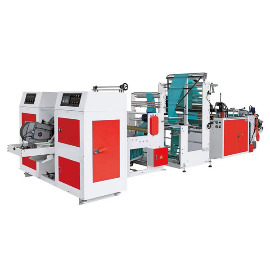
Plastic Bag Making Machine
The HMI (Human-Machine Interface) plays a crucial role in operator efficiency and error reduction. Modern HMIs feature high-resolution touchscreens with intuitive navigation, displaying real-time production data: current BPM, total count, reject count, efficiency, and alarm status. The HMI software includes a recipe management system that stores all machine parameters (temperatures, pressures, lengths, registration settings) for each bag type. A recipe changeover can be executed in under 2 minutes, significantly reducing downtime. The HMI also provides diagnostic screens with graphical representations of the machine's motion axes, showing current positions and following errors. For maintenance, the HMI includes a service mode with manual jogging of each axis, a logbook of alarms and events, and a trend view for critical variables like temperature and pressure. Advanced HMIs support remote access via web server, allowing authorized personnel to monitor production from a mobile device or PC. Cybersecurity is increasingly important – the HMI and PLC use encrypted communication and user authentication to prevent unauthorized access.
Safety control is integrated into the system, with safety PLCs handling emergency stop, light curtains, door interlocks, and two-hand controls. Safety-rated sensors and actuators are used, with a separate safety network (e.g., PROFIsafe) ensuring fail-safe operation. The safety function must stop all hazardous motion within 50 ms of triggering. Redundancy is employed for critical safety functions – dual-channel inputs and outputs with cross-monitoring. All safety events are logged with time stamps for audit purposes. The control system also includes predictive diagnostics: by monitoring motor currents, vibration (via accelerometers), and temperature trends, it can predict bearing wear, heater degradation, or misalignment. Alarm thresholds are adaptive – a machine learning algorithm analyzes historical data to set dynamic limits, reducing false alarms while capturing real anomalies. This predictive capability extends machine life and reduces unplanned downtime.
Integration with higher-level systems (MES/ERP) is achieved via OPC UA or REST APIs. The control system sends production counts, downtime reasons, and quality metrics to the plant's management system, enabling real-time production tracking and data analytics. The machine also supports cloud connectivity for remote monitoring by the supplier, who can provide proactive support and software updates. The software architecture is modular, allowing easy addition of new features like a leak tester or a printer. Firmware updates are delivered via secure download, with version control to ensure traceability. By implementing a robust, real-time control system,
bag making machinery achieves high precision, flexibility, and connectivity, meeting the demands of Industry 4.0 and smart manufacturing.