Bag Making Machinery Technical Deep Dive: Film Handling and Tension Control Dynamics
Film handling is the backbone of bag making machinery, as any variation in tension directly affects bag dimensions, seal integrity, and registration accuracy. The tension control system must maintain a constant web tension from the unwind roll to the pull rollers, despite changes in roll diameter, film elasticity, and machine speed. The system typically comprises an unwind brake (mechanical or regenerative), a tension sensor (load cell or dancer arm), and a controller that adjusts the brake torque or motor speed to maintain the setpoint. The film passes through a dancer roll assembly – a free-floating roll that provides mechanical buffering and acts as a tension transducer. The dancer position is measured by a potentiometer or encoder, and its deviation from the center position signals the controller to adjust the unwind speed. The dynamic behavior of the dancer is modeled as a mass-spring-damper system, where the spring constant is determined by the film's elasticity and the air pressure on the dancer cylinder. The natural frequency of the dancer must be at least 5-10 times the machine's cycle frequency to respond adequately to speed changes. For a 250 BPM machine (4.16 Hz), the dancer natural frequency should be above 20 Hz.
Load cell-based tension measurement offers higher accuracy and faster response than dancer systems, as it directly measures the force exerted by the film. Load cells are installed on a fixed roller, and the sum of the forces on the roller (film tension and gravity) is measured. The tension signal is fed to a PID controller that adjusts the unwind motor torque (in servo-driven unwinds) or the brake current (in passive unwinds). The PID gains are tuned using the Ziegler-Nichols method, but adaptive control is often employed to handle varying roll inertia as the roll diameter changes. The controller's bandwidth must be high enough to reject disturbances from the pull rollers – for example, when the sealing bar engages, it creates a momentary increase in film pull force. Feed-forward control is added: the controller receives a speed signal from the pull rollers and adjusts the unwind torque accordingly, reducing the phase lag. The tension setpoint is typically 10-30 N for LDPE films, but varies with film stiffness and width.
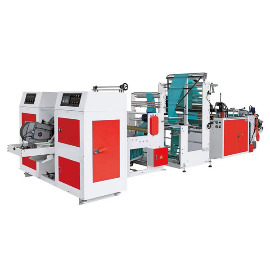
Plastic Bag Making Machine
Web guiding ensures the film stays centered on the machine. An edge sensor (ultrasonic or optical) detects the film edge position and sends a correction signal to a steering roller or a laterally movable unwind stand. The steering roller is mounted on a pivot, and its angle is adjusted to steer the film back to center. The guiding system has a deadband to avoid constant corrections, and its response time must be slower than the tension control to avoid interference. For films with poor edge quality, a line guide (detecting a printed line) is used. The sensor's resolution is typically 0.1 mm, and the correction accuracy is ±0.5 mm. In advanced machines, a camera-based web inspection system simultaneously checks for defects and guides the web.
Tension fluctuations cause bag length variations, wrinkling, and sealing defects. The main sources of disturbances are roll eccentricity, non-round cores, film thickness variations, and thermal expansion. To mitigate these, the unwind uses a roll diameter calculation based on measured film thickness and length – this is used to adjust the tension setpoint as the roll unwinds. Some machines employ a second dancer or a load cell after the pull rollers to monitor tension in the sealing section independently. The sealing section tension is often set lower than the unwind tension to prevent film stretching during sealing. The pull rollers are servo-driven with a position loop that ensures precise film advance per cycle, independent of tension variations. Their surface is coated with a high-friction material (e.g., polyurethane) to prevent slip. The pull roller servo's velocity loop is tuned for high bandwidth (above 100 Hz) to reject load disturbances.
For biodegradable and recycled films, tension control is even more critical as these films have lower tensile strength and are more prone to stretching. The tension setpoint must be reduced by 20-30% compared to virgin PE, and acceleration ramps must be gentler. Some machines feature a tension profiler that adjusts tension based on film position – for example, lower tension during sealing to avoid deformation. The control system records tension trends and can alert if tension exceeds safe limits, preventing film breaks. Advanced tension control integrates with the registration system – if registration error increases, the tension controller can adjust the setpoint slightly to compensate for film slip. By mastering film handling dynamics,
bag making machinery can achieve high-speed, defect-free production on a wide range of materials, from thin LDPE to heavy biodegradable blends.