Bag Manufacturing Equipment Technical Deep Dive: Auxiliary Systems and Upstream/Downstream Integration
A modern bag manufacturing plant is not just a bag making machine – it includes a range of auxiliary systems that feed raw material, recycle waste, transport finished bags, and automate packaging. These systems enhance productivity, reduce labor, and improve material utilization. The upstream side includes resin silos, pneumatic conveying lines, and gravimetric blending systems. The resin pellets are stored in silos, and a vacuum or pressure conveying system transports them to the extruder's hopper. A gravimetric blender mixes different resin grades, masterbatches, and additives in precise proportions (within ±0.5%). The blender is controlled by a PLC that adjusts the feed rates based on the extruder's throughput. For integrated extrusion-bagging lines, the blender ensures consistent film properties, reducing sealing defects. The conveying system includes filters and magnets to remove contaminants. The silos are equipped with level sensors and aeration systems to prevent bridging.
Downstream auxiliary systems include edge trim granulators, scrap reclaimers, and product conveyors. During bag making, edge trims from the film slitting and punching operations are generated. These trims are typically 2-5% of the film weight. An edge trim granulator, located near the bag maker, chops the trims into flakes and pneumatically conveys them back to the extruder's feed hopper (for in-line recycling) or to a storage bin for later use. In-line recycling requires careful control of the recycled flake percentage (usually 10-30%) to maintain film quality. The granulator blades must be kept sharp to produce clean flakes; dull blades generate fines that degrade the film. The recycling system also includes a melt filter on the extruder to remove contaminants from the recycled material. For plants without extrusion, the edge trims are compressed into bales and sold as scrap.
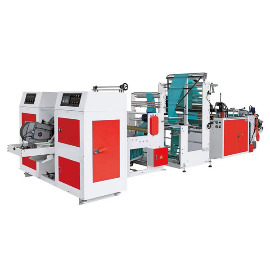
Plastic Bag Making Machine
Conveying systems transport finished bags from the bag maker's stacker to the packaging area. This can be a belt conveyor, a roller conveyor, or a pneumatic conveyor (for lightweight bags). Conveyor speed is synchronized with the bag maker's output. The bags are counted and grouped into bundles, which are then fed to a stretch wrapper or a case packer. Case packers automatically place bundles into cartons or corrugated boxes, and the filled cases are conveyed to a palletizer. A palletizer stacks the cases on pallets in a predefined pattern; robotic palletizers are common for flexibility. The palletized loads are then wrapped with stretch film for shipment. Automation of these downstream steps reduces manual labor significantly – a fully automated line can be operated by just one or two operators for monitoring.
Integration of auxiliary systems with the bag maker's control is essential. The PLC communicates with the granulator, conveyor, and palletizer via industrial Ethernet. The edge trim conveyor speed is adjusted based on the bag maker's production rate to prevent overflow. The granulator's motor current is monitored to detect jams. The case packer's count is compared with the bag maker's production count to ensure accuracy. An OEE (overall equipment effectiveness) dashboard displays the performance of all systems, and alarms are generated for any deviation.
Maintenance of auxiliary systems involves cleaning the granulator blades, checking the conveyor belts for wear, lubricating the palletizer's moving parts, and calibrating the blend scales. The pneumatic conveying lines need periodic inspection for leaks and filter cleaning. By integrating these auxiliary systems,
bag manufacturing equipment achieves high levels of automation, ensuring consistent production flow, minimal waste, and lower operating costs, making large-scale bag production economically viable and competitive.