Bag Manufacturing Equipment Technical Deep Dive: Extrusion-Bagging Integrated Lines
Bag manufacturing equipment can be configured as an integrated line where film extrusion is directly coupled with bag making, eliminating the intermediate roll storage and handling. This approach reduces labor, improves material utilization, and enables real-time control of film properties for bag quality. The line starts with a blown film extruder or cast film extruder that produces the film. The extruder melts resin pellets (HDPE, LDPE, LLDPE, or blends) and forces the melt through a die to form a tubular or flat film. For blown film, the bubble is inflated, cooled by air rings, and collapsed into a flat tube. The film thickness is controlled by a combination of die gap, screw speed, and take-off speed. An automatic gauge control system, using a beta gauge or infrared sensor, measures thickness across the film and adjusts the die gap or air ring to maintain uniformity within ±5%. The film is then fed directly into the bag making section – no winding and rewinding. This eliminates the need for an unwind stand and tension control, as the film speed is synchronized with the extruder's output. The bag making section pulls the film from the collapsing frame and performs sealing, cutting, and stacking as in a standalone machine. The entire line is controlled by a central PLC that coordinates the extruder's output with the bag maker's speed, ensuring a steady material flow.
The integration requires precise speed matching. If the bag maker pulls faster than the extruder supplies, the film will stretch and thin out; if slower, the film will sag and form folds. A dancer roll with a position sensor is placed between the extruder and the bag maker to absorb speed variations. The dancer's position is used to adjust the extruder's screw speed or the bag maker's pull speed. The response time must be fast – a PID controller with feed-forward from the bag maker's speed signal. For high-speed lines (over 200 BPM), a buffer zone with a festoon accumulator may be needed to allow for roll changes in the bag maker or extruder die cleaning. The extruder's melt temperature is critical – any variation changes the film's rheology, affecting sealing behavior. The control system monitors melt temperature and pressure, adjusting the heater zones and screw speed to maintain stability.
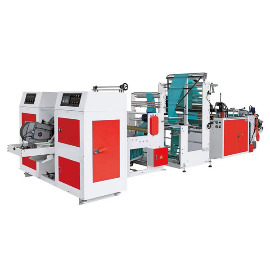
Plastic Bag Making Machine
For co-extrusion, the line produces multi-layer films with different properties – e.g., a sealant layer (LLDPE) for easy sealing, a barrier layer (EVOH) for oxygen protection, and a structural layer (HDPE) for strength. Each layer is fed from a separate extruder into a co-extrusion feed block or die. The layer thickness ratios are controlled by the individual extruder speeds. The integration of a co-extrusion line with a bag maker is more complex because the die's melt flow must be balanced across layers; any imbalance causes layer thickness variations that affect the bag's seal strength and barrier. An automatic layer thickness gauge is used to adjust each extruder's output. The line must also handle the purge and transition when changing resin grades – this produces scrap that must be diverted.
Real-time quality feedback is a key advantage of integrated lines. The thickness gauge, seal strength tester (in-line), and vision inspection camera provide data to the control system. If a seal defect is detected, the system can adjust the sealing temperature or pressure immediately. If thickness drifts, the die gap is adjusted. The data is logged for SPC (statistical process control) and can be sent to the plant's MES. The integrated line also reduces material waste, as there is no edge trim rewind or unwinding scrap. The overall efficiency is higher by 5-10% compared to separate extrusion and bag making.
Maintenance of integrated lines requires skills in both extrusion and bag making. The extruder screws and barrels need regular wear checks; the bag maker's sealing bars need cleaning. The integration adds complexity – if one section fails, the entire line stops. Therefore, redundancy in critical components (e.g., spare heater bands, thermocouples) is essential. The line also requires more floor space, but the savings in labor and material often justify the investment. By implementing extrusion-bagging integrated lines, manufacturers achieve higher efficiency, consistent quality, and lower production costs, making them competitive in large-volume bag production.